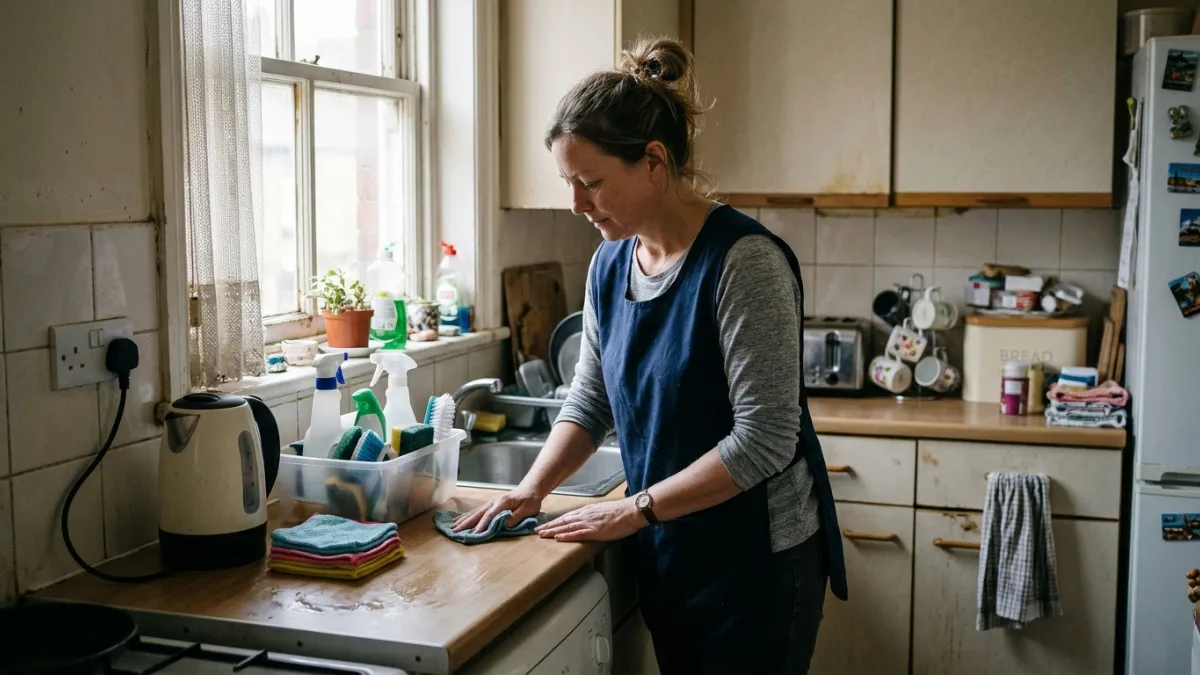
The lowest sensible cleaner hourly rate for a self-employed sole trader in the UK in 2026 is about £19 an hour: that is what it takes to match an employee on the National Living Wage for the same working week. About £21 an hour matches the real Living Wage, and in London the figure is around £23. Below those rates, once you count unpaid travel between houses, holidays, your car and your supplies, you are working for less than the legal minimum an employer would have to pay you.
Those figures are not a survey of what other cleaners advertise. They come from a cost model you can rebuild with your own numbers, using the 2026/27 wage rates, HMRC’s mileage rate and realistic hours for a full-time sole trader. Below are the rates table, the method, a worked example with tax and National Insurance, how to price deep cleans, changeovers and office contracts, and the tax rules once you start trading. Every rate and threshold was checked against GOV.UK and the Living Wage Foundation on 1 November 2026.
Cleaner hourly rate in 2026: what you need to charge
The table takes a cleaner who books 30 hours of cleaning a week, spends another 4 hours driving between houses and 1 hour on messages, keys and invoices, and takes 6 weeks off a year (5.6 weeks’ holiday plus a few sick days). That gives 1,380 paid cleaning hours a year. Each row asks a simple question: what do you have to charge per cleaning hour to earn a given wage for every hour of a 35-hour week, all year round, after covering about £3,270 of costs?
| Benchmark you want to match | Hourly wage | Annual pay, 35 h × 52 weeks | Rate to charge per cleaning hour |
|---|---|---|---|
| National Living Wage (21 and over), from April 2026 | £12.71 | £23,132 | £19.13 |
| National Living Wage from April 2027 | £13.21 | £24,042 | £19.79 |
| Real Living Wage, UK outside London (2026/27) | £14.10 | £25,662 | £20.97 |
| London Living Wage (2026/27), with higher travel and parking costs | £15.45 | £28,119 | £23.20 |
| An experienced, fully booked cleaner aiming for £30,000 profit | – | £30,000 | £24.11 |
The National Living Wage figures are the statutory minimum wage rates on GOV.UK. The real Living Wage and London Living Wage are the voluntary rates the Living Wage Foundation announced on 15 October 2026. For London the costs rise to about £3,900 a year to allow for parking and transport. None of this is the market rate in your town; it is the rate below which your business quietly stops paying you properly.
How to work out your own hourly rate as a self-employed cleaner
The mistake we see most often is taking an employee’s hourly wage and charging that. An employer pays for holidays, travel between jobs and the time spent on the phone. When you work for yourself, nobody pays you for any of it, so every one of those hours has to be recovered from the hours you actually clean. This is the method behind the table:
- Decide what you want to earn in a year before tax. For a fair floor, multiply a benchmark wage by your total working hours a week and by 52.
- Count your billable hours honestly: booked cleaning hours a week multiplied by the weeks you will really work. In practice a full-time solo cleaner books 28 to 32 hours, not 40.
- Add up a year of business costs: mileage, your own kit and products, insurance, phone, bookkeeping and an accountant if you use one.
- Divide earnings plus costs by billable hours. That is your minimum hourly rate.
- Check it against the jobs you actually do and round to a figure you are happy to say out loud.
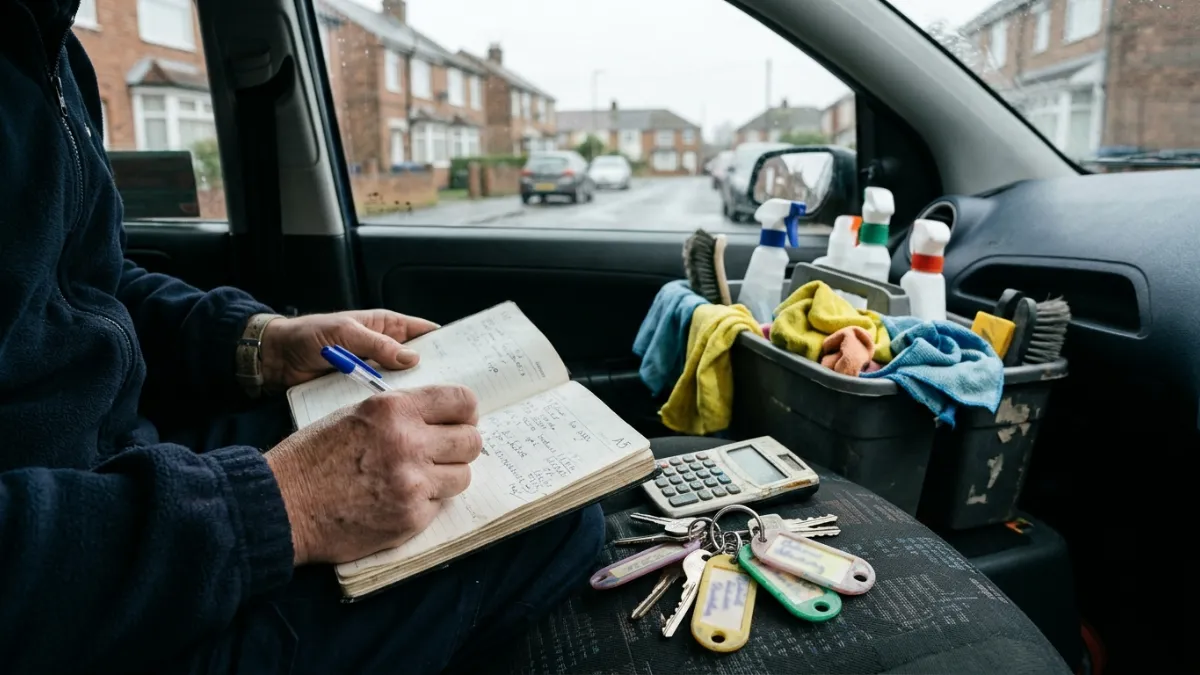
Our £3,270 of yearly costs is made up of 4,000 business miles at HMRC’s simplified rate (£2,200), £300 of your own cloths, mop heads and products for the clients who don’t supply theirs, £120 of public liability insurance, £300 for phone and bookkeeping, £250 for an accountant and £100 for tabards and odds and ends. The mileage figure uses the simplified expenses rate of 55p a mile for the first 10,000 miles, which rose from 45p on 6 April 2026. Insurance premiums vary a lot, so put in your own quote. If your clients supply everything and you walk or cycle between jobs, your costs and your minimum rate both fall.
Travel is the cost people underestimate. Three houses a day with 20 minutes between each is an hour a day in the car, five hours a week, none of it paid and already one more than our model allows. Grouping clients by postcode does more for your income than squeezing an extra 50p an hour out of them.
Part-time cleaners often assume their floor is lower. It isn’t. Take 15 booked hours a week, with 2 hours of driving and half an hour of admin. Mileage and products roughly halve, but insurance, phone and the accountant cost the same, so yearly costs come to about £2,020 on our assumptions. Matching the National Living Wage for 17.5 hours a week means £11,566 a year, and (£11,566 + £2,020) ÷ 690 billable hours gives £19.69, slightly more than the full-time figure.
Worked example: a full-time sole trader cleaner charging £21 an hour
Take a sole trader in Leeds with twelve regular households, a mix of weekly and fortnightly visits, filling 30 hours a week at £21 an hour. Profits are taxed in England for 2026/27, with the £12,570 personal allowance, 20% basic rate and Class 4 National Insurance at 6% on profits between £12,570 and £50,270. With profits above £7,105, Class 2 is treated as paid, so her State Pension year still counts and there is nothing extra to pay.
| Line | Self-employed cleaner at £21/h | Employed cleaner on the real Living Wage |
|---|---|---|
| Takings or gross pay | 1,380 h × £21 = £28,980 | 35 h × 52 × £14.10 = £25,662 |
| Business costs | £3,270 | none (employer pays) |
| Taxable profit or pay | £25,710 | £25,662 |
| Income tax at 20% above £12,570 | £2,628.00 | £2,618.40 |
| National Insurance | Class 4, 6%: £788.40 | Class 1, 8%: £1,047.36 |
| Take-home for the year | £22,293.60 | £21,996.24 |
| Per week, averaged over 52 | £428.72 | £423.00 |
| Employer pension on top | none, funds her own | 3% of qualifying earnings, about £583 |
So £21 an hour as a sole trader leaves you in almost exactly the same place as an employed cleaner on the real Living Wage, minus their workplace pension. It is a fair living, not a windfall. In Scotland the starter and basic bands for 2026/27 would cut her income tax to about £2,588, roughly £40 less, while National Insurance is the same everywhere in the UK.
Now run the same diary at £16 an hour. Takings fall to £22,080, profit to £18,810, and over the 1,610 hours she actually works in the year (35 a week for 46 weeks) that is £11.68 an hour before tax, with no holiday pay. That is below the £12.71 National Living Wage. Charging £16 doesn’t make you competitive; it makes you the cheapest person in the street working for less than the minimum wage.
Time every job for your first month, door to door, and write it down. You will find two or three houses that always run over. Those are the ones to re-price first, because the client is already getting more hours than they pay for.
Regular cleans, deep cleans and other jobs: how to price each one
One hourly rate does not fit every job. Regular domestic work is the base; anything heavier, one-off or time-critical deserves more, and long, predictable commercial hours can justify a little less. This is how we would set it out from a £21 base rate.
| Type of job | How we would price it | Example from a £21 base |
|---|---|---|
| Regular weekly or fortnightly clean | Hourly, agreed hours per visit, 2-hour minimum | £42 for 2 hours, £63 for 3 |
| First visit for a new regular client | Deep-clean rate for the first visit only | £26.25 an hour (+25%) |
| One-off deep or spring clean | Fixed quote from estimated hours at +25% | 6 hours: £157.50 |
| After-builders clean | Fixed quote at +40% for dust, filters and repeat passes | £29.40 an hour equivalent |
| Holiday-let changeover | Fixed fee per changeover, linen extra, premium for same-day turnarounds | 2.5 hours: £52.50 plus linen |
| Office cleaning contract | Hourly, invoiced monthly; a slightly lower rate can work for guaranteed hours with no travel between sites | 10 hours a week at £19: £190 a week |
| Ironing | Hourly at the base rate, or per item once you know your speed | £21 an hour |
End of tenancy work is usually priced per property rather than per hour, because the tenant or agent wants a fixed figure and a checklist. Our guide to end of tenancy cleaning prices covers it room by room. The same guide shows that a firm employing cleaners on the National Living Wage has to sell each cleaner-hour at roughly £27 to cover holiday pay, employer’s National Insurance, pension and a margin. That is your real competition from agencies, and it leaves an independent cleaner room to charge £21 to £23 and still be the better deal.
A house cleaned fortnightly takes longer per visit than one cleaned weekly, so price the hours it needs. If a fortnightly 2-hour slot keeps running to 2 hours 40, the booking is wrong, not your speed.
London and the regions: does the rate change?
The legal minimum is the same across the UK, so the floor of about £19 applies in Truro as much as in Tottenham. What changes is cost and what clients are used to paying. In London, parking, congestion and longer journeys push costs up, and the London Living Wage sets a higher benchmark, which is why our London figure lands at about £23. Outside London, the households to target are the ones who have used an agency: an agency paying the National Living Wage needs to charge around £27 a cleaner-hour, so £21 to £22 from a reliable independent cleaner looks like good value rather than expensive.
In smaller towns some households balk at £20. Rather than drop the rate, change the offer: a fixed fortnightly visit at a set price, a 2-hour minimum and a tight route. Short travel and a full diary can justify a slightly lower rate, never one below your own floor.
Minimums, cancellations, travel and products: the small print that protects your rate
A good hourly rate leaks away through short visits and late cancellations. A 1-hour clean across town costs you the same journey as a 3-hour one, so set a 2-hour minimum and stick to it. For houses outside your usual area, either add a travel charge (55p a mile beyond, say, five miles is easy to explain because it is HMRC’s own rate) or decline politely.
Put your cancellation terms in writing before the first visit. A common and clear term is that less than 24 hours’ notice, or no access on the day, is charged in full. With households you are dealing with consumers, so the term has to be fair and proportionate under consumer law; charging for a slot you could not refill is fair, charging double is not. If you agree the work by text or email, the client also has a 14-day cancellation right and should ask in writing if they want you to start sooner.
On products, decide once and say it in your price: many regular clients prefer their own, and if you bring yours, build them into the rate or add a small flat charge per visit. Hold keys only with a signed note and check that your insurance covers loss of keys, because a lost bunch can mean paying for new locks.
Review prices once a year. April is the natural moment because the National Living Wage rises then: from £12.71 to £13.21 in April 2027, an increase of 3.9%. On a £21 rate that is about 80p, so moving to £22 with a month’s written notice is easy to justify. In our experience long-standing clients rarely leave over 80p; they leave when their cleaner burns out.
Tax, National Insurance and VAT for self-employed cleaners
You must register as a sole trader with HMRC once your income from self-employment goes over £1,000 in a tax year, and the deadline is 5 October after the end of the tax year in which you started. Below £1,000 the trading allowance covers it, which suits someone doing one or two houses on the side. Above it you file a Self Assessment return each year by 31 January, pay income tax and Class 4 National Insurance on your profit, and from your second year usually make payments on account in January and July.
Making Tax Digital is coming for cleaners sooner than many expect. It applies when your qualifying income, which is turnover from self-employment and property before expenses, passes £30,000 in 2025/26 (quarterly updates from April 2027) or £20,000 in 2026/27 (from April 2028), according to HMRC’s eligibility guidance. The cleaner in our example, turning over £28,980, will be in from April 2028. Our guide to Making Tax Digital for sole traders explains what changes and how to get ready.
VAT is rarely an issue for a solo cleaner: you only have to register if your taxable turnover goes over £90,000 in a rolling 12 months, and you cannot reach that cleaning alone. It matters when you grow into a team, because domestic cleaning is standard-rated and households cannot reclaim VAT, so registration effectively puts 20% on their bill. Our VAT threshold guide covers how the rolling test works and when to plan for it.
Every visit you charge for should end with a proper invoice or receipt, even for households who pay by bank transfer each week; it is far quicker when recurring visits, the weekly rota and the month’s invoicing are worked out in one place, which is what our software for cleaning companies does. Our guide on how to write an invoice as a sole trader lists what to include. With office and other business clients you can also claim statutory late payment interest if a monthly invoice goes unpaid; that law covers business-to-business debts only, not private households.
Check your employment status. If one household or agency gives you most of your hours, sets your times, supplies everything and would not accept a substitute, HMRC may treat you as an employee rather than self-employed, whatever you have agreed. The figures here are for the 2026/27 tax year (6 April 2026 to 5 April 2027) in England, Wales and Northern Ireland; Scotland has its own income tax bands. Ask an accountant to look at your own case.
Frequently asked questions
How much should a self-employed cleaner charge per hour in 2026?
For a full-time sole trader with normal travel and costs, about £19 an hour is the floor that matches the National Living Wage once holidays and unpaid travel are counted. Around £21 matches the real Living Wage outside London and about £23 matches the London Living Wage. Experienced cleaners with full diaries often aim higher.
Is £15 an hour a good rate for a self-employed cleaner?
Not for a full-time cleaner. On our model, £15 for 30 booked hours a week gives £20,700 of takings and £17,430 of profit, which is about £10.83 for each hour actually worked, before tax and with no holiday pay. That is well below the National Living Wage. It can work for a few local hours with no travel and the client’s products, but not as a living.
Do cleaners charge more in London?
Yes, and they need to. The London Living Wage is £15.45 for 2026/27 against £14.10 elsewhere, and parking and travel cost more. On the same hours, a London cleaner needs about £23 an hour to match the London Living Wage.
Should a cleaner charge for travel time or for products?
Within your normal area, build travel into the hourly rate and use a 2-hour minimum. Outside it, a per-mile charge at HMRC’s 55p rate is simple to explain. For products, either include them in the rate or add a small flat fee per visit, and say which in your price list.
Do I need to tell HMRC if I only clean a few houses?
If your cleaning income stays at £1,000 or less in a tax year, the trading allowance covers it and you don’t need to register. Above £1,000 you must register as self-employed by 5 October after the end of that tax year and file a Self Assessment return.
Do self-employed cleaners charge VAT?
Only if they are VAT registered, which is compulsory once taxable turnover passes £90,000 in a rolling 12-month period. A solo cleaner will not get there; a cleaning business with a team might, and then 20% VAT is added to every household bill.
Sources
Rates and thresholds checked on 1 November 2026. Check your own case with an accountant.
- GOV.UK: National Minimum Wage and National Living Wage rates
- Living Wage Foundation: what is the real Living Wage (2026/27 rates)
- GOV.UK: National Insurance rates for the self-employed
- GOV.UK: Rates and thresholds for employers 2026 to 2027 (income tax bands, Scottish rates)
- GOV.UK: Simplified expenses for vehicles
- GOV.UK: Check if you’re eligible for Making Tax Digital for Income Tax
- GOV.UK: Set up as a sole trader
Software for cleaning businesses
Recurring contracts, a weekly rota and the month’s invoicing worked out for you, plus quotes clients accept with a signature, ready to invoice in one click. €19.95/month · or €199.50/year with 2 months free · no tie-in.