
SOAP notes for physiotherapy split every patient contact into four parts: Subjective (what the patient tells you), Objective (what you see, test and measure), Assessment (what you make of it) and Plan (what you did and what happens next). The HCPC doesn’t insist on SOAP by name, but it does require full, clear and accurate records completed promptly, and SOAP is the simplest way to meet that on a busy list.
Here is what goes under each heading, one low back pain case taken from first assessment to discharge, a template to copy, and the UK GDPR and retention points that catch out private practitioners. The patient is illustrative.
What SOAP notes are, and what the HCPC expects of physiotherapy notes
SOAP notes are a structured way of writing a clinical entry under four headings: Subjective, Objective, Assessment and Plan. The format grew out of the problem-oriented medical record introduced in American medicine in the late 1960s, and it is now the default layout for physiotherapy notes in UK private practice and across much of the NHS.
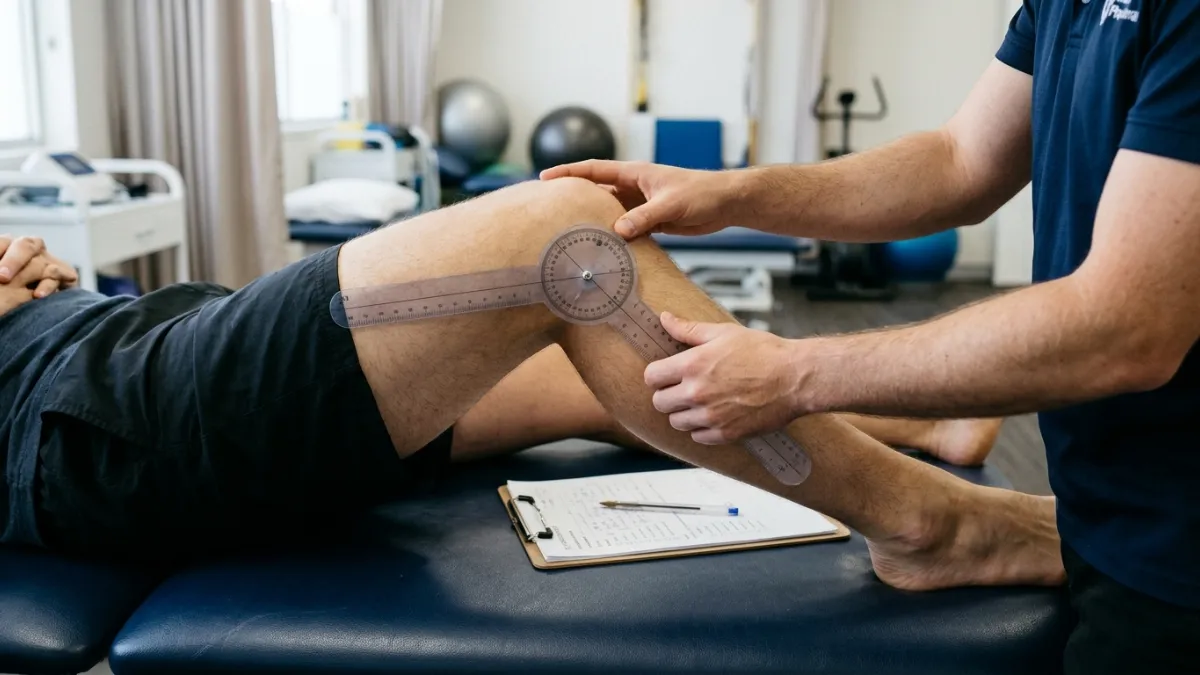
The rule that binds you is standard 10 of the HCPC Standards of conduct, performance and ethics, in their current form since 1 September 2024: keep full, clear and accurate records for everyone you treat, complete them promptly, and protect them from loss, damage or inappropriate access. Standard 1.4 requires valid, informed consent before treatment, and your note is the only proof that conversation happened. No format is named. The practical test is whether a colleague could pick up your note tomorrow and carry on treating, and whether it would stand up if the patient, an insurer or a court read it.
Physiotherapy notes hold more than the SOAP entry: the patient’s name, date of birth and identifier, and for each entry the date, time, setting (clinic, home, video, phone), anyone else present and your signature with name and role. Phone calls, missed appointments, GP letters and the discharge summary belong in the record. Billing doesn’t; invoices to patients or insurers sit in your accounts, and our guide to what a UK invoice must show covers that side. After home visits, keep the mileage log for HMRC separate from the clinical entry too.
The notes do one quiet tax job, though. Treatment by an HCPC-registered physio is exempt from VAT only when its primary purpose is protecting, maintaining or restoring health. If you also run general Pilates classes or sell sports massage as a fitness service, those sales can count towards the £90,000 VAT registration threshold, and a proper clinical record is what shows which sessions were treatment.
Subjective: what the patient tells you
On a first assessment the subjective covers the presenting complaint (PC), its history (HPC), the pain picture, the 24-hour pattern, aggravating and easing factors, past medical history (PMH), drugs (DH), social history (SH) and the patient’s goals. On a follow-up it shrinks to what has changed and how the home programme went.
Numbers beat adjectives. “6/10 worst, on rising; 2/10 by mid-morning; sits 20 minutes before needing to stand” tells the next clinician far more than “bad in mornings”. Quote the patient when the words carry information (“like a hot wire down the leg”). Goals should be testable: “drive to Birmingham without stopping” is a goal, “reduce pain” isn’t.
Write red flag screening down even when every answer is negative, and say what you asked. “Red flags NAD” proves little if a patient later develops cauda equina syndrome and says nobody asked about their bladder. “CES screen: saddle sensation normal, bladder and bowel unchanged, no sexual dysfunction” takes ten seconds longer. The commonest failing we see is a subjective copied forward from last week, leaving a patient who has reported the same “6/10” for five sessions while every objective sign improves.
Objective: what you see, test and measure
Write the objective so it can be repeated: range of movement in degrees or against a landmark (“flexion: fingertips to mid-shin”), strength on the Oxford scale (0 to 5), neurology by level and side, special tests by name with side and result, palpation, and a functional test such as a 30-second sit-to-stand count. Note the test position when it changes the figure, record useful negatives, and if you chose not to repeat a test, say why.
Validated outcome measures show the patient they are improving and show insurers that treatment changed something. Pick one or two that fit and repeat them at fixed points.
| Measure | What it scores | Typical use |
|---|---|---|
| NPRS (numeric pain rating scale) | Pain from 0 to 10 | Every contact: now, best and worst |
| PSFS (Patient-Specific Functional Scale) | Up to five activities the patient picks, each 0 (unable) to 10 (as before) | Any condition; first visit, every few sessions, discharge |
| ODI (Oswestry Disability Index) | Low back pain disability, 0 to 100% | Low back pain; start and discharge |
| NDI (Neck Disability Index) | Neck-related disability, ten sections | Neck pain and whiplash |
| QuickDASH | Upper limb function, 0 to 100 | Shoulder to hand |
| LEFS (Lower Extremity Functional Scale) | Twenty activities, 0 to 80 | Hip to foot |
| Keele STarT Back tool | Nine questions: low, medium or high risk | First visit, to match treatment to risk |
Assessment: your clinical reasoning in a few lines
The assessment is the section most often skipped and the one that matters most if your care is questioned, because it is the only place your thinking appears. Give a working diagnosis or impression, severity and irritability, the factors driving the problem (load, work, sleep, fear of movement), whether specific pathology has been ruled out, and on follow-ups, progress against goals and measures.
“LBP” is not an assessment. “Acute non-specific LBP, directional preference for extension; no neuro deficit; red flags negative; ODI 36%; fear of ‘a slipped disc’ limiting activity” tells a colleague what you think and what would make you think again. If you can’t reach a diagnosis, say so and say what you’ll do: “unclear, letter to GP if no change by session 3” reads far better later than false certainty.
Plan: treatment given, consent and what happens next
Record treatment in enough detail to repeat it. Manual therapy needs technique, level, grade and dose (“central PA L4, grade III, 3 × 30 s”); acupuncture needs points, needle count, duration and “all needles removed”; exercise needs name, sets, reps, load and frequency, because “HEP issued” tells nobody what the patient is doing.
For routine exercise and advice, “findings and plan explained, verbal consent” is enough. For manipulation, acupuncture or an intimate examination, write what risks you explained, that questions were invited and whether a chaperone was offered. Then the safety-netting you gave and how, the review interval, when you’ll re-measure, any referral, and what would trigger discharge or escalation. A did-not-attend gets its own entry with what you did about it.
Write the assessment line before the patient leaves the room. It forces you to commit to a view while the findings are fresh, and it’s the hardest line to reconstruct at seven in the evening with eleven other patients in your head.
Worked physio example: low back pain from first assessment to discharge
Mr K is 44, a self-employed plasterer with three weeks of low back pain after carrying plasterboard upstairs. He is paying privately because he can’t afford more time off. His initial assessment, with common UK abbreviations:
| Section | Entry (initial assessment, 45 min, clinic) |
|---|---|
| S | Central and R-sided LBP 3/52 after carrying plasterboard upstairs. Intermittent ache R buttock, nil below knee, no P&N. NPRS 7/10 worst (on rising), 3/10 best; stiff 30 min mornings. Worse sitting >20 min (driving), bending, lifting; eased by walking, heat. CES screen: saddle sensation normal, bladder and bowel normal, no sexual dysfunction. No night pain, weight loss or cancer history. PMH nil. DH ibuprofen 400 mg PRN. SH 4 days off work; 5-a-side weekly. “Worried something has slipped.” Goals: full days on site in 3/52; drive 1 hr. |
| O | No lateral shift. Flexion fingertips to mid-shin, P↑ end range; extension 50%. Repeated extension in standing ×10: pain centralised, NPRS 7 → 5. SLR R 70° (back pain only), L 80°. Myotomes L2–S1 5/5, dermatomes intact, reflexes equal. Central PA L4 stiff, reproduces pain. PSFS 4.3/10. ODI 36%. STarT Back medium risk. |
| A | Acute non-specific LBP, directional preference for extension. No neuro deficit; red flags negative. Fear of damage and long drives slowing recovery. Good prognosis. |
| P | Findings explained, reassured re “slipped disc”; verbal consent. Central PA L4 grade III 3 × 30 s. HEP: press-ups in lying ×10 every 2–3 hrs; walk 10 min ×3 daily. Light tasks this week, two-person lift for full sheets, driving break every 30 min. CES safety-netting verbal and written card. RV 1/52; re-measure PSFS and ODI at session 3. |
The follow-up a week later is much shorter, and every line can be checked against the first note:
Session 2 · day 8 · 30 min · clinic
S  "About 50% better." NPRS 4/10 worst. Stiff 10 min. Drives 40 min.
   HEP 4-5×/day. Buttock ache gone. CES screen re-checked: negative.
O  Flexion fingertips to knee, no P↑. Extension full, pain-free.
   Neuro not repeated (no leg symptoms).
A  Improving as expected; ready to load.
P  Hip hinge 10 kg kettlebell 3×10, bridges 3×12. Full days from
   Monday, full sheets two-person. RV 10 days, PSFS and ODI then.
By session 4 he is back to full days. The discharge entry records final scores, goals met, the self-management plan and an invitation to get back in touch within six weeks if it flares. If an insurer is funding treatment, expect to send a short progress report before more sessions are authorised; the table below is most of it.
| Measure | Day 1 | Session 3 (day 18) | Discharge (day 32) |
|---|---|---|---|
| NPRS, worst | 7/10 | 3/10 | 1/10 |
| PSFS average | 4.3/10 | 7.0/10 | 8.7/10 |
| ODI | 36% | 18% | 8% |
| Goal: full days on site | Not met | Light duties | Met |
The same follow-up, written badly and well
| Section | Weak entry | Why it fails | Better entry |
|---|---|---|---|
| S | Pt better. | Better than what? | NPRS 4/10 worst (was 7); drives 40 min (was 20) |
| O | ROM improved. | Nothing to compare next time | Flexion to knee (was mid-shin), no P↑ |
| A | (blank) | No reasoning on record | Improving as expected; ready to load |
| P | Cont Rx. HEP. | Nobody could repeat it | Hip hinge 10 kg 3×10, bridges 3×12; RV 10 days |

SOAP notes template for physiotherapy (copy and paste)
Paste this into a document, a paper form or your clinic system and delete the prompts you don’t need. Keep abbreviations to a list the whole clinic agrees, and always spell out the side.
A word on tick-box templates: drop-downs suit the objective, but we’d keep the subjective and the assessment as free text. Six identical ticked entries in a row are exactly what makes an insurer or a fitness to practise panel wonder whether anyone was really reassessing.
INITIAL ASSESSMENT
Patient: [name] · DOB: [ ] · ID: [ ]
Date/time: [ ] · Setting: [clinic/home/video/phone] · Present: [ ]

S  PC / HPC (onset, mechanism, progress):
   Pain: area · NPRS now [ ] best [ ] worst [ ] · 24-hr pattern:
   Aggravating:              Easing:
   Red flags asked, and answers:
   PMH:      DH (incl. anticoagulants):      SH (work, sport):
   Goals (measurable):
O  Observation · AROM/PROM (figure, side) · Strength (Oxford 0-5)
   Neuro · Special tests (name, side, result) · Palpation
   Functional test · Outcome measures:
A  Impression · Severity/irritability · Contributing factors
   Pathology ruled out? · Prognosis:
P  Explained · Consent [verbal/written] · Treatment (technique, dose)
   HEP (exercise, sets × reps, load, frequency) · Advice
   Safety-netting [verbal/written] · Review · Re-measure · Referral
Signed: [name, role]

FOLLOW-UP
Date/time/setting:
S  Change since last time · NPRS · HEP adherence · new symptoms
O  Re-tested signs, compared with last figures
A  Progress against goals
P  Treatment · HEP changes · next review or discharge
Signed:
Budget the time, because it’s real work. As a rough estimate, at six minutes per follow-up note and fifteen per new patient, a physio seeing 25 follow-ups and five new patients a week spends 25 × 6 + 5 × 15 = 225 minutes writing: five 45-minute slots. That has to be paid for in the session length or the price, and our guide to what private therapists charge per hour looks at how session prices are built.
Keeping physiotherapy notes digitally: UK GDPR, security and retention
Clinical notes are special category health data under the UK GDPR. A private physio usually relies on the treatment contract as the lawful basis and on Article 9(2)(h) with paragraph 2 of Schedule 1 to the Data Protection Act 2018 (health or social care purposes) for the health data, which covers processing by or under the responsibility of a health professional such as an HCPC-registered physiotherapist. That condition doesn’t rest on the patient’s consent, which is a separate matter from consent to treatment. Keeping notes on a computer or phone also means paying the annual data protection fee: £52 in the lowest tier, where most sole practitioners and small clinics sit (£47 by direct debit), or £78 for a larger practice. The regulator has formally been the Information Commission since 30 September 2026, but it still goes by the ICO name.
Whatever you use, ask who can open a record, whether you can prove who did, and whether you can get everything out if the laptop is stolen or the provider disappears. Individual logins, two-step verification, encryption, an access log, backups and a full export answer those. A provider that stores your notes is your data processor and needs a written contract. Paper goes in a locked cabinet, never in the car overnight, and exercise videos shouldn’t live on your personal phone. Corrections stay visible: strike through once, initial and date on paper; add a dated amendment in a digital record rather than overwriting.
Patients can ask for their notes at any time. The ICO’s right of access guidance gives you one month, extendable by two for complex requests, and usually no fee; the old £50 charge for copies of health records ended in 2018, so don’t ask for it. Since 19 June 2026 you also need a way to receive data protection complaints and must acknowledge them within 30 days, and a breach that risks harm to patients must be reported to the ICO within 72 hours.
Room renters should settle one question before the first patient: who is the controller of the notes? If the patients are yours, normally you; if the clinic books, bills and owns the list, probably the clinic. Agree it in writing, including what happens to the notes if you leave. In the physiotherapy software from Gremio Software, patient records, a first assessment with a 0–10 pain scale and session notes with a pain chart sit together, with two-step verification and a log of who opens each record.
How long to keep physiotherapy notes
No statute sets a period for private physiotherapy notes. The usual benchmark is the NHS England Records Management Code of Practice; it is written for the NHS and organisations working under contract to it, but it’s the yardstick private practice uses too: eight years after treatment ends for most adult records, and until the 25th birthday for children (26th if they were 17 when treatment ended). The logic follows the Limitation Act 1980: a personal injury claim generally has three years from the injury or from when the claimant knew of it, and for a child the clock starts at 18. Scotland and Northern Ireland publish their own codes, and some periods differ, so a clinic in Glasgow or Belfast should check the local one.
Tax records run on a shorter clock, at least five years after the 31 January filing deadline, as our guide to Self Assessment for sole traders explains. Don’t let that decide when clinical notes are shredded, and plan who will hold them, and answer access requests, if you retire or sell the practice.
Check your own case: if you treat NHS-funded patients, work for an insurer or see children, confirm your retention and access policy with your indemnity insurer or a data protection adviser.
Frequently asked questions
Do physiotherapists in the UK have to use SOAP notes?
No. The HCPC requires full, clear and accurate records completed promptly and kept secure, but no particular format. SOAP is popular because it makes your reasoning visible and keeps notes consistent across a clinic.
How soon after a session should I write my notes?
As soon as possible, ideally before the next patient; HCPC standard 10.2 asks for records completed promptly. If you add something later, date and time it when you write it rather than backdating it.
Can a patient see their physio notes?
Yes. Under the UK GDPR a patient can ask for a copy, and you normally have one month to provide it free of charge. Write every note on the assumption the patient will read it.
What should a SOAP note for a video appointment include?
The same four sections, plus the mode of contact, where the patient was, their agreement to a remote appointment and what you couldn’t assess. Say how you assessed movement and whether you need to see them in person.
How long should physio notes be kept in the UK?
The usual benchmark is the NHS England Records Management Code: eight years after treatment ends for adults, and until the 25th birthday for children, or the 26th if they were 17 when treatment ended. Keep tax records on their own, shorter clock.
Can I use abbreviations in physiotherapy notes?
Yes, if they are standard and your clinic keeps an agreed list. Avoid home-made shorthand and anything that could mean two things, and always write the side in full. A patient who asks for a copy should be able to follow the note with that list in hand.
Sources
Standards and rules checked on 9 November 2026. Check your own case with your indemnity insurer, your professional body or the ICO.
Physiotherapy software with patient records
Patient records, a first assessment with a 0–10 pain scale, session notes with a pain chart and home exercises as a PDF, with two-step verification and a log of who opens each record. €19.95/month · or €199.50/year with 2 months free · no tie-in.