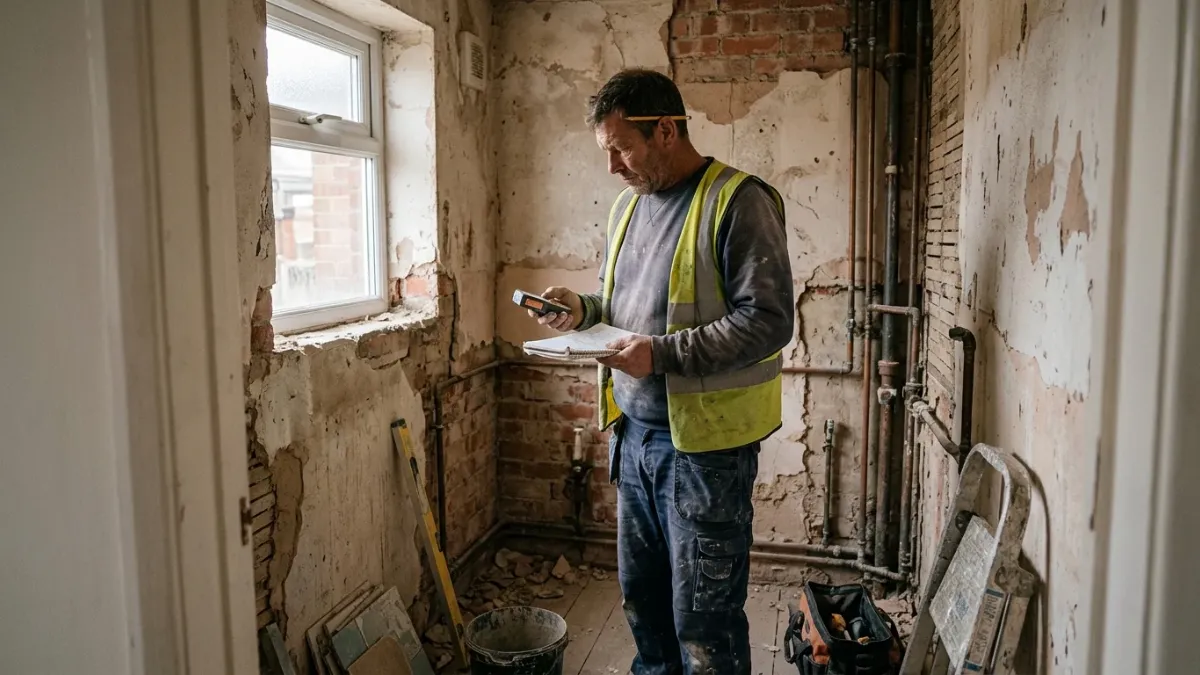
To price a building job, measure the work, price the materials with a waste allowance, cost your labour at a day rate that actually pays you, add overheads and a contingency, set your profit as a margin on the selling price, and only then add VAT if you are registered. The building quote template further down follows that order and is filled in for a small bathroom refit, so you can copy the layout into Word or Excel and swap in your own figures.
Most underpriced quotes go wrong at the margin step rather than the measuring one: a 20% markup is not a 20% margin, and on an ordinary domestic job the gap is worth hundreds of pounds. This guide covers that, the difference between a quote and an estimate, waste allowances, VAT and the domestic reverse charge, and the terms that stop a customer reading your price as a promise about things you never priced. Every number in the worked example is illustrative, chosen to make the sums easy to follow, so use your own merchant prices and day rates. The legal and tax points were checked against GOV.UK and legislation.gov.uk on 1 November 2026.
Quote or estimate: what a building quote has to do
A quote is a fixed price for a defined scope of work. An estimate is your best professional guess before the scope is fixed, and it should say so. The difference matters because the law reads what you write generously in the customer’s favour. Under the Consumer Rights Act 2015, anything you say or write about the service can become a term of the contract if the customer relied on it (section 50), and where no price was agreed the customer owes a reasonable price and no more (section 51). A bare ‘about £6,500’ on headed paper, with no word ‘estimate’ and no list of exclusions, will be argued over.
In practice we’d use an estimate early, when the customer is deciding whether a project is affordable and you have not yet seen behind the plaster, and a quote once the scope, the chosen finishes and the access are settled. If you have to price an older house before the walls are opened up, say so on the document and carry provisional sums and a contingency for the unknowns, as the template below does. Whichever you issue, put the word at the top, give a validity period and list what is excluded.
Step 1: measure the job and split it into items
Pricing starts with quantities, not with a feeling about what the job is worth. Measure on site, keep the dimensions with the quote, and photograph everything, including the stopcock, the consumer unit and the route from the van to the room. The bathroom in our example is 2.4 m by 1.9 m with a 2.4 m ceiling.
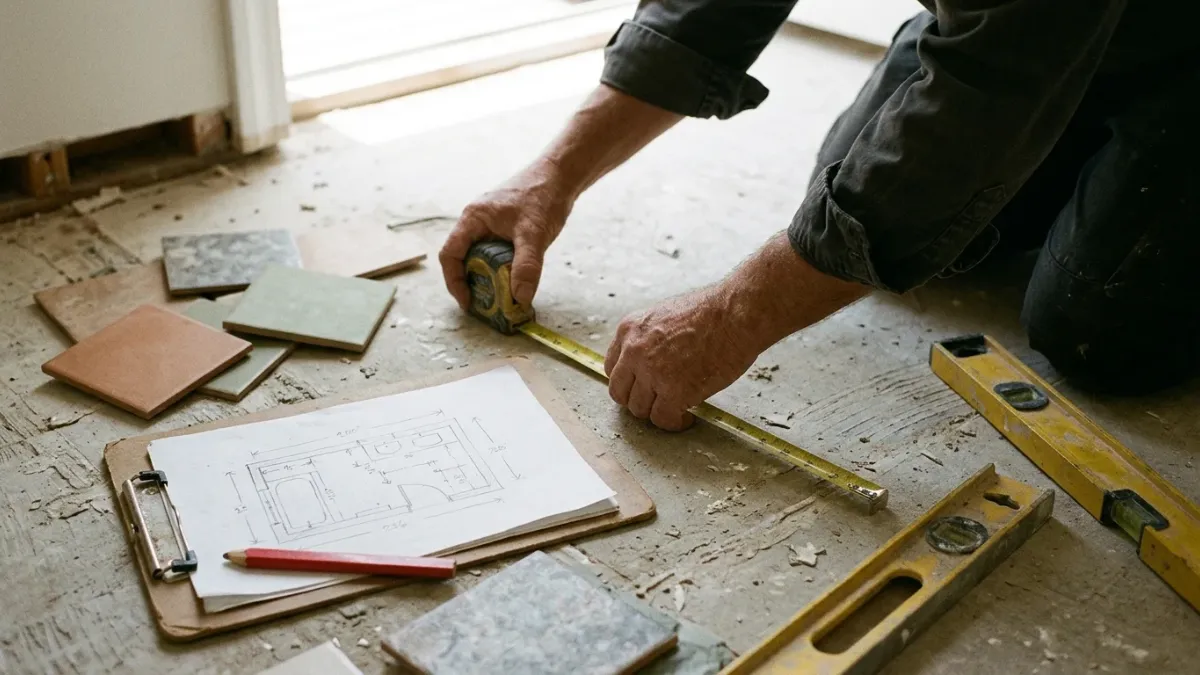
The floor is 2.4 × 1.9 = 4.56 m². The walls run 2 × (2.4 + 1.9) = 8.6 m round the room, and 8.6 × 2.4 gives 20.64 m². Take off a door (0.8 × 2.0 = 1.60 m²) and a window (0.9 × 0.9 = 0.81 m²) and the tileable wall area is 18.23 m², which goes on the quote as 18.2 m². Do the same for plasterboard, skim and paint rather than reusing one figure for everything, because openings come off some items and not others.
Then split the job by stage and trade: strip-out, first-fix plumbing, boarding and tanking, tiling, second fix, electrics, waste removal. Pricing by stage lets you test each line against your own output (a competent tiler on a small room with plenty of cuts might manage 5 to 6 m² a day, which is how this example arrives at four days for 22.8 m²), and it hands you a ready-made list for stage payments and variations later.
Step 2: price the materials, and allow for waste
Take materials from a current merchant quote or price list for the exact product, never from memory, and note how long that price is held. Add delivery or collection, apply your trade discount, then add waste: the material you cut, break, mis-order or cannot use because of pack sizes.
| Material | Typical waste allowance | Why |
|---|---|---|
| Wall tiles, straight lay | 10% | Edge cuts and breakages |
| Floor tiles, diagonal or herringbone | 15% to 20% | Angled cuts at every edge |
| Plasterboard | 10% | Off-cuts round openings |
| Laminate or engineered flooring | 8% to 10% | Cut ends and pattern matching |
| Timber and skirting | 10% to 15% | Lengths, defects and mitres |
| Bricks and blocks | 5% | Breakage and cuts |
| Paint | 5% to 10% | Cutting in and touch-ups |
Treat these as starting points, not rules. A room with boxed-in pipework and a patterned tile deserves more, and a plain rectangle in large-format tiles needs less. Keep the allowance visible in your working, because it is the first thing a customer queries when you list 20.1 m² for an 18.2 m² wall. In the example the wall tiles take 10%, the floor tiles 12% for the cuts round the WC and bath, plasterboard 10%, and adhesive is worked from the bag’s coverage rate: 22.8 m² at roughly 4 m² a bag is 5.7 bags, and 10% on top makes seven. Things you buy whole, such as a tanking kit or a WC pan, carry no waste.
Anything the customer has yet to choose belongs in a prime cost (PC) sum rather than in your price. The example carries £1,150 for the suite, taps and shower valve. If the customer picks something dearer the difference is added, and if cheaper it comes off. That single line heads off most arguments about the final bill.
Step 3: price your labour at a day rate that pays you
The commonest labour mistake is to quote what the local market is supposed to pay rather than what the working year allows. Work it backwards. There are about 260 weekdays in a year; take off 8 bank holidays, 20 days of holiday and 5 for sickness and training and you have 227. Quoting, admin, travelling, waiting for deliveries and snagging eat about a fifth of those, leaving roughly 180 chargeable days. If you want to take £40,000 out of the business before tax, that is £40,000 ÷ 180 = £222 a day, rounded up to £225 in the example. Your own target and your own non-chargeable days will give a different figure; the method is what matters.
That £225 pays you for your time. It does not pay for the van, the insurance or the accountant, which come in at Step 4, and it does not include anyone else’s wage. A labourer who costs you £140 a day once holiday pay and employer’s National Insurance are counted goes on the quote at £140, not at what lands in their hand. Subcontractors go on at their agreed price, and if you pay them under the Construction Industry Scheme our CIS guide explains how the deduction works.
Step 4: overheads, contingency and margin
Overheads are the costs of being in business that no single job pays for. Add up a year of them: say the van £4,800, insurance £1,200, tools £1,500, phone and software £700, the accountant £900, marketing £600 and £1,000 of odds and ends, which makes £10,700. Divide by what you spend directly on jobs in a year (labour, materials and subcontractors), say £134,000, and overheads are 8% of direct cost. That percentage goes on every quote, and you recalculate it once a year.
Contingency is separate and depends on the job. On a 1930s house where nobody has seen the pipework we would carry 5% of the direct cost, leaving out PC sums; on a new extension with everything exposed, less. You can show it as a line or fold it into your rates, but include it. Margin comes last, and this is where price lists go wrong, because markup and margin are different numbers. Markup is a percentage added to cost; margin is the share of the selling price you keep.
| Method | Price on a £5,915.91 cost | Profit | Margin on the price |
|---|---|---|---|
| Add 15% markup | £6,803.30 | £887.39 | 13.0% |
| Aim for a 15% margin | £6,959.89 | £1,043.98 | 15.0% |
| Add 20% markup | £7,099.09 | £1,183.18 | 16.7% |
| Aim for a 20% margin | £7,394.89 | £1,478.98 | 20.0% |
Adding 15% and making 15% are £156.59 apart on this one bathroom. To get a margin of m, divide cost by (1 − m). We price on margin because every other number in the business, from card fees to VAT, is a share of the selling price, and we would not go below 15% on small domestic work: the margin has to pay for the job that overruns.
Expert tip: in a spreadsheet, order quantity is =ROUNDUP(net quantity × (1 + waste), 1) and the selling price is =cost / (1 − margin). Lock the overhead, contingency and margin percentages in single cells so changing one never means retyping a quote.
VAT on a building quote
If you are not VAT-registered, your quote carries no VAT line and you must not show one. Registration is required once taxable turnover passes £90,000 in any rolling 12 months, and our VAT threshold guide explains the tests and the deadlines. An unregistered builder pays VAT on materials with no way to reclaim it, so the materials line has to reflect that.
If you are registered, most building work for a homeowner is standard-rated at 20%. GOV.UK’s guidance for builders sets out the 5% rate for converting a building into a house or flats, changing it from one type of residential use to another, and renovating certain empty homes, plus the zero rate for new dwellings. Installing energy-saving materials such as insulation, solar panels and heat pumps in a home in Great Britain is zero-rated until 31 March 2027 and returns to 5% from 1 April 2027, under VAT Notice 708/6. Get the rate right before the quote goes out: VAT you did not charge still has to be paid, and it comes out of your margin.
Between VAT-registered contractors the picture changes. Under the domestic reverse charge, if your customer is VAT-registered, the payment is reported under CIS and the work is standard or reduced rated, you do not charge the VAT and the customer accounts for it on their own return. A homeowner is neither VAT-registered nor reporting under CIS, so the reverse charge does not apply and you charge VAT in the ordinary way. When it does apply, the document must say so, and HMRC’s guidance accepts wording such as ‘reverse charge: VAT Act 1994 Section 55A applies’. The reverse charge also falls away if the customer confirms in writing that it is an end user or intermediary supplier.
Check your own case: the VAT rate depends on the building, the work and who the customer is, and a wrong rate is paid out of your own pocket. If you are unsure whether a job is 20%, 5% or 0%, ask your accountant or HMRC before the quote goes out, not after the invoice.
Building quote template with a worked bathroom example
Copy the tables and the terms block below into Word, Excel or Google Sheets and replace the example figures. Prices are net of VAT and illustrative: they show how the method works, not what a bathroom costs where you are. If you quote often, a price bank saves retyping, and the builders’ version of Gremio Software keeps your own rates and quotes in one place.
Part 1: the details at the top
| Field | What to write |
|---|---|
| Document | QUOTE (fixed price), quote number, date, and the date it stays valid until (30 days is common) |
| Your business | Trading name, address, phone, email, VAT number if registered, insurer and cover level |
| Customer | Name, billing address, and the site address if it differs |
| Job | Bathroom refit, first-floor bathroom 2.4 m x 1.9 m, 14 Larch Road |
| Scope | Strip out the existing suite and wall tiles; replumb; board and tank; tile floor and walls; fit the customer-chosen suite; new extractor and lighting by our electrician |
| Start and duration | Start date to be agreed on acceptance; about 12 working days on site, subject to deliveries |
| Access and conditions | Customer provides parking, water and power; working hours 8am to 5pm, Monday to Friday |
| Exclusions | Decorating; making good outside the bathroom; asbestos removal; structural or hidden defects found on opening up |
Part 2: the priced items
| Ref | Description | Qty | Unit | Rate (£) | Amount (£) |
|---|---|---|---|---|---|
| A1 | Wall tiles, 300 x 600 ceramic (18.2 m² + 10% waste) | 20.1 | m² | 21.00 | 422.10 |
| A2 | Floor tiles, 600 x 600 porcelain (4.56 m² + 12% waste) | 5.1 | m² | 26.00 | 132.60 |
| A3 | Flexible tile adhesive, 20 kg (5.7 bags + 10% waste) | 7 | bag | 19.50 | 136.50 |
| A4 | Grout, 5 kg | 3 | bag | 12.50 | 37.50 |
| A5 | Tanking kit for the shower area | 1 | kit | 88.00 | 88.00 |
| A6 | Moisture-resistant plasterboard (5 sheets + 10% waste) | 6 | sheet | 14.50 | 87.00 |
| A7 | Pipework, valves and fittings (allowance) | 1 | item | 165.00 | 165.00 |
| A8 | Sealant, trims, fixings, dust sheets | 1 | item | 55.00 | 55.00 |
| Materials subtotal | 1,123.70 | ||||
| PC | Prime cost sum: bath or shower enclosure, WC, basin, taps and shower valve, as chosen by the customer | 1 | sum | 1,150.00 | 1,150.00 |
| B1 | Strip out suite and tiles, bag up (labourer) | 1.5 | day | 140.00 | 210.00 |
| B2 | First-fix plumbing | 1.5 | day | 225.00 | 337.50 |
| B3 | Boarding, tanking and skim | 2.0 | day | 225.00 | 450.00 |
| B4 | Tiling, walls and floor (about 5.7 m² a day) | 4.0 | day | 225.00 | 900.00 |
| B5 | Second-fix plumbing and fitting the suite | 2.0 | day | 225.00 | 450.00 |
| Labour subtotal | 2,347.50 | ||||
| C1 | Electrician, fixed price: extractor, lighting, bonding | 1 | item | 420.00 | 420.00 |
| C2 | Skip and waste removal | 1 | item | 245.00 | 245.00 |
| Subcontract and waste subtotal | 665.00 | ||||
| Direct cost (A + PC + B + C) | 5,286.20 |
Part 3: totals, margin, VAT and payment stages
| Line | How it is worked out | Amount (£) |
|---|---|---|
| Direct cost | From Part 2 | 5,286.20 |
| Overheads | 8% of direct cost | 422.90 |
| Contingency | 5% of direct cost excluding the PC sum (£4,136.20) | 206.81 |
| Total cost | 5,915.91 | |
| Selling price before VAT | Cost ÷ 0.85 (£6,959.89), rounded up to the next £10 | 6,960.00 |
| Profit in the price | 6,960.00 − 5,915.91 = 15.0% of the price | 1,044.09 |
| VAT at 20% | Only if you are VAT-registered and the reverse charge does not apply | 1,392.00 |
| Total payable | 8,352.00 | |
| Stage 1: on acceptance | 20%, enough to cover ordering the suite | 1,670.40 |
| Stage 2: at second fix | 50% | 4,176.00 |
| Stage 3: within 7 days of completion | Balance | 2,505.60 |
When each stage falls due, send an invoice for that stage; our guide to writing an invoice in the UK lists what it must show. The deposit is sized to the PC sum (£1,150 plus VAT is £1,380), so you never fund the customer’s suite out of your own pocket.

Part 4: terms to paste under the table
QUOTE TERMS

1. This is a fixed-price quote for the work described, valid for 30 days from the
   date above. After that the price may change.
2. The price includes the labour and materials listed. Items marked PC sum are
   allowances for goods you choose. The final price is adjusted up or down to the
   cost of the items you select.
3. Excluded: decorating, making good outside the work area, asbestos removal and
   structural work.
4. If we find something that could not reasonably be seen before opening up (for
   example rotten joists or unsafe wiring) we will stop, tell you in writing and
   agree a price before carrying on.
5. Changes you ask for after acceptance will be priced in writing and agreed
   before we do them. They may move the completion date.
6. Payment: 20% on acceptance, 50% at second fix, balance within 7 days of
   completion. Our invoices show the VAT position.
7. We hold public liability insurance of £[amount] with [insurer]. Workmanship
   is guaranteed for [12] months. Manufacturers' guarantees apply to products.
8. Waste from our work is removed by skip or by our registered waste carrier
   (registration number [number]).
9. If you accept this quote at your home you may cancel within 14 days of
   accepting. Our cancellation notice is attached. We will not start work
   within that period unless you ask us to in writing.
10. To accept, sign and date below, or reply "Accepted" from the email address
    this quote was sent to.

Customer signature: ____________________   Date: ______________
Quote mistakes that cost builders money
Pricing from last year’s figures. Merchant prices move, and a quote valid for 30 days at a price you have not checked since spring is a quote you fund yourself. Re-price the materials block on the day you send it, and shorten the validity when prices are unsettled.
Leaving out the dull costs. Skip hire, parking permits, floor and stair protection, tool hire and travel all need a line. If you take your own waste to a tip, check whether you must register as a waste carrier; GOV.UK says registration is usually free if you only transport waste you produce yourself.
Agreeing the job at the kitchen table without the cancellation paperwork. Trading Standards guidance on the Consumer Contracts Regulations, published on Business Companion, treats a quote left for the customer to think about as an on-premises contract with no cancellation right, but a contract agreed during the visit gives the customer 14 days to cancel. You must give the cancellation information on paper or another durable medium before the contract is made, failing to do so is an offence, and the cancellation period can be extended by up to 12 months. The customer can ask you in writing to start within the 14 days; if they then cancel, they pay a proportion for the work done. When in doubt, attach the notice. It costs nothing.
Frequently asked questions
What should a building quote include?
Your business and the customer’s details, a quote number and date, a clear scope with exclusions, the price broken into materials, labour and any PC or provisional sums, the VAT position, payment stages, a validity period, your insurance details and the terms for changes and cancellation. The template above covers each of these.
What is the difference between a quote and an estimate for building work?
A quote is a fixed price for a defined scope that the customer can accept. An estimate is an approximate price that can change as the scope or the unknowns become clear. Say which one you are giving at the top of the document, because anything you write about the service can become a contract term under the Consumer Rights Act 2015.
How much waste should I add to materials?
Typically about 10% for straight-lay tiles and plasterboard, 15% to 20% for diagonal or herringbone patterns and 5% for bricks and blocks. These are rules of thumb: use the manufacturer’s coverage rate and the room’s actual layout, and buy whole items without any waste allowance.
How long should a building quote stay valid?
Thirty days is common for domestic work. Shorten it if material prices are moving or a supplier’s price is held for less time, and say clearly that the price may change after the date shown.
Do I charge VAT on a building quote?
Only if you are VAT-registered. Most work for a homeowner is 20%, with 5% and 0% for specific conversions, renovations, new dwellings and energy-saving installations. If your customer is a VAT-registered contractor reporting the payment under CIS, the domestic reverse charge usually applies and you do not charge the VAT.
Can I charge for giving a quote?
Nothing stops you, but tell the customer before you visit and offer to credit the fee against the job if they go ahead. For simple jobs most builders quote free; a measured survey or a detailed specification is a different matter.
Sources
Rules checked on 1 November 2026. Check your own case with your accountant or with HMRC.
- GOV.UK: VAT for builders
- GOV.UK: VAT on energy-saving materials and heating equipment (Notice 708/6)
- GOV.UK: How to use the VAT domestic reverse charge if you supply building and construction services
- HMRC: VAT Reverse Charge Manual, VATREVCON37100 (invoices)
- legislation.gov.uk: Consumer Rights Act 2015, section 50
- legislation.gov.uk: Consumer Rights Act 2015, section 51
- Business Companion: Consumer contracts, off-premises sales
- GOV.UK: Register as a waste carrier, broker or dealer
Quotes built from your own prices
Measurements, items and a price bank of your own rates, so each new quote starts from your real numbers. Builders, renovation and quoting. €19.95/month · or €199.50/year with 2 months free · no tie-in.