
If you are a sole trader or in a partnership, the self-employed mileage allowance lets you claim a flat rate for every business mile instead of adding up what the vehicle really costs. For the 2026-27 tax year HMRC’s rate is 55p a mile for the first 10,000 business miles in a car or van and 25p after that, or 24p a mile on a motorcycle. That figure replaces fuel, insurance, servicing, road tax, MOT and the cost of the vehicle itself, so you claim the flat rate or actual costs, never both.
Two details catch people out this winter. The 55p rate only started on 6 April 2026, so the 2025-26 return due by 31 January 2027 still uses 45p. And limited companies can’t use it at all: directors are paid a mileage allowance by the company instead. Our short view: on an older van or a car you’d own anyway, the flat rate usually wins on money and on paperwork; on a new van bought outright it rarely does, and whichever you pick is locked in for as long as you keep that vehicle.
HMRC mileage rates for the self-employed in 2026
HMRC calls this simplified expenses for vehicles. The rates sit in section 94F of the Income Tax (Trading and Other Income) Act 2005, and the Taxation (Energy and Vehicles) Act 2026 raised the first band from 45p to 55p from 6 April 2026, the first change since 2011.
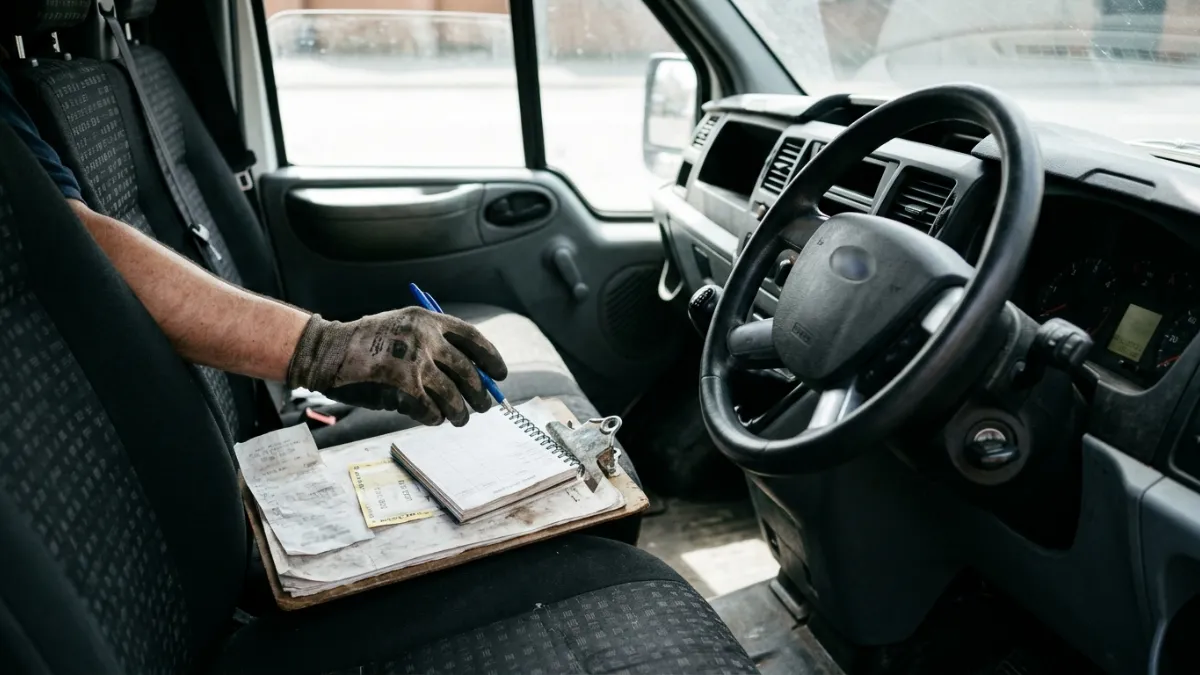
| Vehicle | 2025-26 | 2026-27 | 2027-28 (announced) |
|---|---|---|---|
| Car or van, first 10,000 business miles | 45p | 55p | 55p |
| Car or van, each mile over 10,000 | 25p | 25p | 35p |
| Motorcycle, every mile | 24p | 24p | 24p |
| Bicycle | Not covered | Not covered | Not covered |
The last column comes from the Treasury announcement of 26 October 2026, two days before the Budget: 55p is being locked in, and the rate above 10,000 miles is due to rise to 35p, expected from 6 April 2027 for employees and the self-employed alike. It still needs legislation, so treat it as planned until section 94F and HMRC’s rates page change.
The 10,000-mile band runs per tax year and, as section 94F is worded, counts the business miles of all the cars and vans you use the flat rate for. Two vans on the flat rate share one 55p band. The rate is the same for diesel, petrol, hybrid and electric, and it doesn’t rise when you carry an apprentice: the 5p passenger rate is for employees only.
What the flat rate covers, and what you still claim
The rate stands in for owning and running the vehicle: fuel or charging, insurance, servicing, repairs, tyres, road tax, MOT, breakdown cover and depreciation. HMRC’s manual (BIM75005) leaves the costs of a particular journey outside it, so parking, tolls and the congestion charge on a business trip are claimed on top. Fines and penalty charge notices never are.
The 20p a mile you see quoted for bicycles is the employee rate, not a simplified expense. A self-employed courier on a bike claims actual costs, and under the cash basis the bike itself is an allowable expense for its business share.
Who can claim the self-employed mileage allowance
Simplified expenses are open to sole traders and to partnerships with no company as a partner. There’s no turnover limit, and they work under the cash basis (the default since 2024-25) or traditional accounting. Vans count as goods vehicles and get the same rates as cars. Excluded are cars built for commercial use, such as black cabs, and dual-control cars used by driving instructors.
If you trade through a limited company and drive your own vehicle, the equivalent is the approved mileage allowance payment (AMAP). The company reimburses your business miles at up to 55p and 25p, free of tax and National Insurance, and deducts the cost for corporation tax; you keep the same kind of log. If it pays less, you can claim Mileage Allowance Relief on the shortfall, but that only gives tax relief at your rate, not the cash, so we’d pay the full allowance when the company can afford it. Directors also fall under the statutory commuting rules, including the 24-month rule below.
Flat rate or actual costs: a choice you live with
Once you use the flat rate for a vehicle, you must keep using it for as long as that vehicle is in the business, and you can only change method when you replace it. The reverse holds too: if capital allowances have ever been claimed on a vehicle, or you’ve deducted a van’s price under the cash basis, it can’t go onto the flat rate later. The first return that includes the vehicle decides. The choice is made vehicle by vehicle, though: a plasterer can keep the van on actual costs and put the car he uses for pricing jobs on the flat rate.
Actual costs means the business share of the running costs plus relief for buying the vehicle, and that relief depends on what it is:
- Vans: deducted as an expense under the cash basis, or 100% annual investment allowance under traditional accounting.
- Cars: always capital allowances. A new zero-emission car gets 100% if bought by 5 April 2027 (the Budget of 28 October 2026 did not extend it). Others get 14% a year (18% before April 2026) at up to 50g/km of CO2, or 6% above that; the 14% main rate is due to fall to 12% from 6 April 2027.
- Double cab pick-ups with a one-tonne payload: treated as cars for capital allowances since 6 April 2025, so a new diesel one gets 6% a year, not the full write-off a van gets.
With any private use, every figure is cut to the business percentage, proved from the mileage log. Enquiries that go badly usually start with a round, generous number (90% business on the household’s only car) and no log behind it.
Worked example: an electrician’s van over four years
Example. An electrician buys a second-hand diesel van for £14,000 in April 2026 and drives 15,000 miles a year, 12,000 on business (80%). Running costs are £5,200 a year: £2,640 diesel, £1,150 insurance, £900 servicing, tyres and repairs, £510 road tax, MOT and breakdown cover. Assume four years like this, the announced 35p from 2027-28, and a sale for £5,000 at the end.
| Flat rate | Actual costs (cash basis) | |
|---|---|---|
| Year 1 (2026-27) | £6,000 (10,000 × 55p + 2,000 × 25p) | £15,360 (£11,200 van + £4,160 running) |
| Years 2 to 4 | £18,600 (3 × £6,200) | £12,480 (3 × £4,160) |
| Sale of the van | Nothing to add back | −£4,000 (80% of £5,000) |
| Total relief | £24,600 | £23,840 |
Over four years the methods finish within £800. The difference is timing: actual costs give £9,360 more relief in year one, worth about £2,430 to a basic-rate taxpayer once 6% Class 4 National Insurance is added. That’s why most trades who buy a van outright go for actual costs. Make the van cheaper or the miles higher and the flat rate pulls ahead.
Now a mobile hairdresser with a ten-year-old petrol hatchback worth £5,000, doing 7,000 business miles out of 10,000 (70%) and spending £2,600 a year to run it. Actual costs give £1,820 of running costs plus 6% of £5,000 (its CO2 is over 50g/km) cut to 70%, about £2,030 in year one. The flat rate gives 7,000 × 55p, which is £3,850, every year, with no fuel or garage receipts to keep for income tax.
Our rule of thumb: the flat rate suits an older or cheaper vehicle, high mileage or anyone who loses receipts; actual costs suit an expensive van bought outright, a new electric car, or low mileage in a costly vehicle. If unsure, run both sums over the vehicle’s expected life before the first return.
Your tax claim and what you charge clients for travel are separate things. A travel charge is turnover (with VAT if you’re registered); HMRC’s rate is just a handy benchmark. Our guide to trade day rates shows how van costs feed into a day rate.
Business miles or commuting? The rules for tradespeople
Only journeys made wholly and exclusively for the business count, and home-to-work travel isn’t one. Where your “work” is depends on how the trade runs, which is where most arguments with HMRC start.
No fixed base: the job starts at home
A plumber, roofer or jobbing builder going from home to a different client every week, with no yard or office, is an itinerant trader. In Horton v Young a bricklayer working on sites up to 55 miles from home was allowed his travel because his places of work kept changing, and HMRC’s manual (BIM37620) accepts home-to-site travel where home is the base of the business.
Keeping tools at home doesn’t make home the base on its own, and a predictable round can become a place of work in itself. In Powell v Jackman a milkman with the same streets every day lost his claim. A cleaner with the same eight houses every week is closer to that milkman than to the bricklayer.
A yard, workshop or salon
With a fixed place of business, home to that place is ordinary commuting, and calling at a supplier on the way doesn’t change that: in Sargent v Barnes a dentist’s detour to his own lab on the drive in was refused (HMRC’s BIM37630). A hairdresser can’t claim home to salon, but salon to a bride’s house on a wedding morning counts. A builder with a yard claims yard to site and site to merchant; home to yard stays private.
Going straight from home to a site without calling at the yard is the grey area. HMRC’s manual has no blanket rule for it, so the claim rests on the yard being a genuine base and the site being a one-off job. We’d claim it when the log shows a different client each time, and drop it when the same site turns up week after week.
The long contract on one site
Employees and directors have a statutory 24-month rule (HMRC’s EIM32080): a site stops being temporary once you spend 40% or more of your working time there over a period that lasts, or is expected to last, more than 24 months. The self-employed have no such rule, so HMRC looks at the facts, and a subcontractor driving to the same hospital job every weekday for 18 months starts to look like a commuter. Ask your accountant before claiming those miles.
Mixed trips need splitting. Dropping the children at school on the way to site makes that leg private. A Saturday run to the merchant for a client’s tiles and your own fence panels is a judgement call; we’d claim it only if the job was the main reason, and say so in the log.
Mileage log: what HMRC expects, with a template
HMRC doesn’t prescribe a form, but it expects a record made at the time; a log written as you go carries far more weight than one rebuilt from your diary in January. For each business journey note the date, from and to, the reason and the miles. Add the odometer reading on 6 April and 5 April: total miles prove your business percentage under actual costs.
| Date | From | To | Purpose (client / job) | Miles | Running total |
|---|---|---|---|---|---|
| 07/04/2026 | Home, LS6 | Client, Headingley | Consumer unit swap, job 031 | 3.8 | 3.8 |
| 07/04/2026 | Headingley | Wholesaler, Kirkstall | Cable and RCBOs, job 031 | 2.6 | 6.4 |
| 07/04/2026 | Kirkstall | Home, LS6 | Return | 2.1 | 8.5 |
| 08/04/2026 | Home, LS6 | Client, Wetherby | EICR and quote, job 032 | 29.8 (return) | 38.3 |
For a spreadsheet or notes app, this is the layout we’d copy:
MILEAGE LOG   Tax year: 2026-27   Vehicle reg: ________
Method for this vehicle: flat rate / actual costs
Odometer 6 April 2026: ________   Odometer 5 April 2027: ________

Date | From | To | Purpose (client, job or invoice no.) | Miles | Cumulative | Parking/tolls £

Cumulative miles at 5 July ____  5 October ____  5 January ____  5 April ____

Claim: first 10,000 x 55p = £____ + remaining ____ x 25p = £____
       + parking and tolls £____ = TOTAL £____
Keep the log and the parking receipts for at least five years after the 31 January deadline for that year, so the 2026-27 log must survive until 31 January 2033. An app or tracker is fine if it exports and shows purpose, not just distance. Writing the quote or invoice number against each trip ties the miles to your books; if you quote and invoice in the Gremio Software version for your trade, that reference is already on every job.
How to claim mileage on your tax return
The log stays with you; HMRC only sees the total. On the self-employment pages of the Self Assessment return (the short SA103S if turnover is under £90,000 and your affairs are simple, otherwise the full SA103F, or the same screens online) the mileage figure goes in the box for car, van and travel expenses, together with business parking and tolls. A partnership claims it once, in the partnership return, and each partner’s share of the profit already reflects it.
Forgotten miles can still be claimed. A 2024-25 return can be amended until 31 January 2027, twelve months after its filing deadline; for older years the route is an overpayment relief claim, within four years of the end of the tax year concerned. The miles people leave out are usually the small ones: Saturday quotes, wholesaler runs, picking up a hired breaker. Rebuilding them needs evidence, such as dated quotes, invoices and merchant receipts, not a guess.
Mileage under Making Tax Digital for Income Tax
With 2024-25 qualifying income over £50,000 you’ve been in Making Tax Digital for Income Tax since 6 April 2026; over £30,000 in 2025-26 brings you in from April 2027, and over £20,000 in 2026-27 from April 2028. Our guide to Making Tax Digital thresholds and dates explains what counts.
Quarterly updates are cumulative from 6 April and due by 7 August, 7 November, 7 February and 7 May. HMRC’s MTD record-keeping guidance treats simplified expenses as an adjustment made before you finalise your Income Tax position, so the flat-rate figure needn’t be in every update. We’d add it each quarter anyway: HMRC’s in-year estimate becomes realistic and you see when you’re about to pass 10,000 miles.
On actual costs, each fuel, insurance or repair payment becomes a digital record with date, amount and category. With turnover under £90,000 the updates can carry one total for expenses, but the records underneath stay digital. The mileage log itself doesn’t have to live inside the MTD software; it’s a supporting record, like the wholesaler’s receipt.
VAT on fuel if you’re VAT registered
The mileage rate is an income tax figure; there’s no VAT to reclaim on 55p a mile. Fuel follows VAT Notice 700/64, and once you’re over the VAT registration threshold you have three options. You can reclaim all fuel VAT and pay the fuel scale charge for each car with private use: on the scales from 1 May 2026 a 140g/km car costs £49 of VAT a quarter and a 200g/km car £82. You can reclaim only the VAT on business fuel, backed by a log that splits business and private miles. Or you reclaim no fuel VAT at all and pay no scale charge.
The scale charge applies to cars only. A van or a one-tonne double cab is a commercial vehicle for VAT, even though the double cab is a car for capital allowances, so you reclaim fuel VAT and apportion for private use. When you pay an employee mileage, you can reclaim VAT on the fuel element using HMRC’s advisory fuel rates, which change every quarter: from 1 September 2026, 16p a mile for a 1,601 to 2,000cc diesel, so about 2.7p of VAT a mile, with fuel receipts dated within the claim period.
The method on your first return binds that vehicle for as long as you keep it, and the business percentage is the first figure HMRC checks. For an expensive, partly private or double cab vehicle, run the sums past your accountant before you file.
Frequently asked questions
Can I claim 55p a mile if I’m self-employed?
Yes, for business miles in a car or van from 6 April 2026, up to 10,000 in the tax year, then 25p. Miles in 2025-26 go on the return due by 31 January 2027 at 45p. You must be a sole trader or a partner in a partnership with no company partners.
Can I claim mileage and fuel as well?
No. The flat rate already covers fuel, insurance, repairs, road tax and depreciation, so adding any of them counts the cost twice. Parking, tolls and congestion charges on business trips can be added.
Can I switch from actual costs to the mileage rate?
Only when you replace the vehicle. Once capital allowances or a cash basis purchase deduction have been claimed on it, it stays on actual costs, and a vehicle on the flat rate stays there while the business uses it.
Do I need fuel receipts if I use the flat rate?
Not for income tax: you need the mileage log and receipts for parking and tolls. If you’re VAT registered and reclaim VAT on fuel, you still need the fuel receipts for that.
Is the rate different for an electric car or van?
No, 55p and 25p apply whatever the vehicle runs on, and they cover charging. If the car is new, compare the flat rate with the 100% first-year allowance for zero-emission cars first, because that can be worth far more in year one.
Should I charge clients mileage at 55p?
You charge whatever you agree: many trades build travel into the day rate, add a call-out fee or charge per mile beyond a set radius. It’s income and goes on the invoice like any other line; see how to write an invoice.
Sources
Rules and rates checked on 1 November 2026. Check your own case with your accountant.
- GOV.UK: Simplified expenses for vehicles
- HMRC BIM75005: simplified expenses, motor vehicles
- ITTOIA 2005 section 94F, as amended in 2026
- HM Treasury, 26 October 2026: mileage rates made permanent
- GOV.UK: Approved mileage rates
- HMRC BIM37620: travel to and between sites
- HMRC BIM37630: home to work by way of a supplier
- HMRC, Budget 2026: main rate writing-down allowance cut to 12%
- HMRC EIM32080: the 24-month rule
- GOV.UK: Capital allowances on business cars
- GOV.UK: MTD for Income Tax, create digital records
- HMRC VAT Notice 700/64: motoring expenses
- GOV.UK: VAT road fuel scale charges from 1 May 2026
- GOV.UK: Advisory fuel rates
Fuel and parking receipts, sorted as you go
Photograph a receipt and Gremio Software’s AI assistant fills in the expense and shows where each figure came from, with 150 receipts a month included. Your accountant gets read-only access to income and expenses, with export to Excel or CSV. €19.95/month · or €199.50/year with 2 months free · no tie-in.