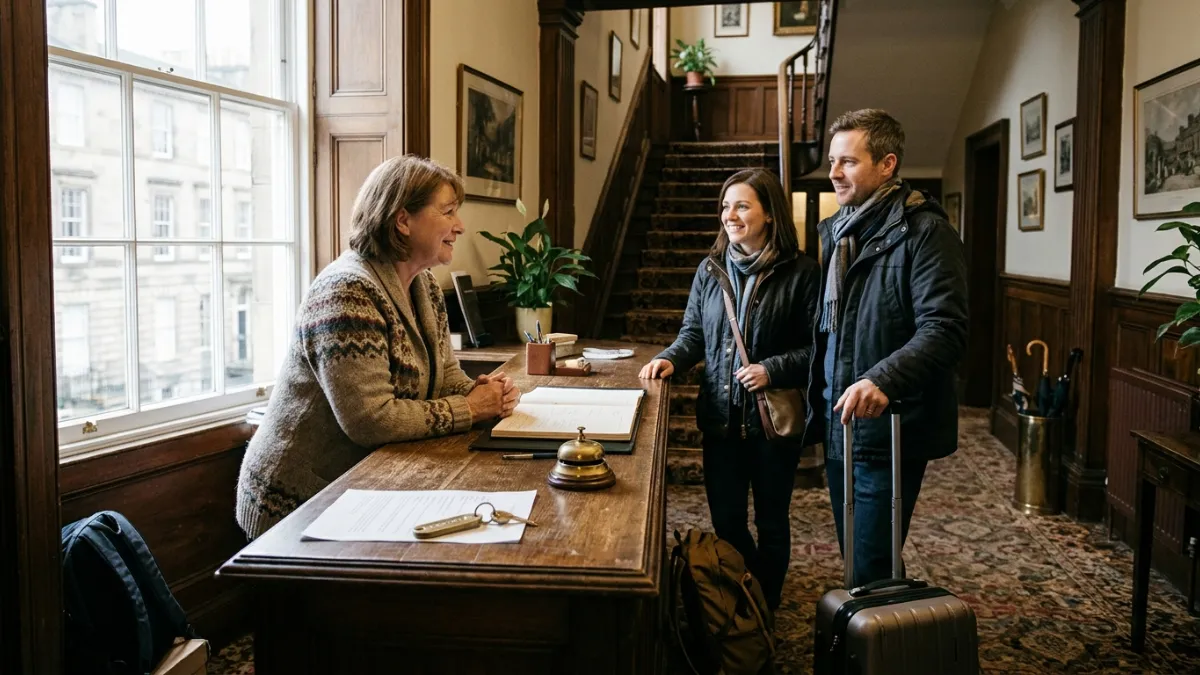
There is no single tourist tax in the UK. What exists is a patchwork: Scotland and Wales have passed laws that let councils charge a visitor levy, England has promised legislation but not yet introduced it, and Northern Ireland has none. Edinburgh became the first place to charge a statutory visitor levy on 24 July 2026, at 5% of the room price for the first five nights, and Cardiff follows on 1 April 2027 with £1.30 per person per night. In England, Manchester and Liverpool already add £1 and £2 per room per night through their hotel business improvement districts.
This guide is written for the people who have to collect it: hotels, guest houses, B&Bs, hostels and self-catering owners. It covers who charges what and from when, how the Edinburgh calculation works with VAT and booking platforms, the Welsh registration deadline that applies even where no levy is charged, and what the government confirmed for England in September 2026.
Tourist tax UK: where it applies in 2026 and 2027
A visitor levy, as the legislation calls it, is a local charge on overnight stays in paid accommodation. The accommodation provider is legally liable for it, adds it to the guest’s bill in most cases, and pays it to the council or the tax authority. The money stays in the area that raises it.

| Area | Legal basis | Rate | Starts | Main limits |
|---|---|---|---|---|
| Edinburgh | Visitor Levy (Scotland) Act 2024 | 5% of the accommodation cost | Stays from 24 July 2026 | First 5 consecutive nights |
| Glasgow | Same Act | 5% | January 2027 | Applies to any stay |
| Aberdeen | Same Act | 7% | April 2027 | Applies to any stay |
| Stirling | Same Act | 3% | June 2027 | First 7 nights |
| West Dunbartonshire | Same Act | 5% | July 2027 | Applies to any stay |
| Cardiff | Visitor Accommodation (Register and Levy) Etc. (Wales) Act 2025 | £1.30 per person per night; 75p per adult in shared hostel rooms and on tent pitches | Stays from 1 April 2027 | Single bookings of 32 nights or more exempt |
| Manchester | Accommodation BID | £1 per room per night plus VAT | Since April 2023 | Accommodation inside the BID zone |
| Liverpool | Accommodation BID | £2 per occupied room per night | Since 1 June 2025 | Hotels and serviced accommodation with rateable value of £45,000 or more |
Two very different models sit in that table. The Scottish and Welsh levies are statutory taxes that every provider in the area must collect, from a one-room B&B upwards. The Manchester and Liverpool charges are business improvement district levies voted for by the hotels themselves, billed to the businesses in the scheme, and passed on to guests by choice. A small guest house outside the Manchester BID zone charges nothing.
Edinburgh tourist tax: how the visitor levy works
The Edinburgh visitor levy is 5% of the accommodation-only part of the price, net of VAT, charged on the first five consecutive nights of each booking. It covers hotels, hostels, guest houses, B&Bs, self-catering and short-term lets, campsites and caravan pitches, and fixed boats or vehicles used as accommodation, including businesses below the VAT threshold. It applies to stays starting on or after 24 July 2026. The only bookings let off are those made and paid for, in full or in part, before 1 October 2025, and only if the contract fixed the dates, the number of rooms and the nightly price and the payment was non-refundable; a refundable deposit does not count.
The detail is where returns go wrong, so here is what the council’s provider guidance (version 2.1, September 2026) actually says.
What you leave out. Meals and drinks, parking, laundry, entertainment and transport to the property are excluded. If breakfast is included in the rate, you deduct what you would reasonably charge for it on its own. Things the guest cannot opt out of, such as standard cleaning, stay in. A separately itemised cleaning fee the guest can genuinely decline can come out.
The five-night cap. It applies per booking, using the actual value of the first five nights, not an average. A company that books one room for 14 nights and rotates two employees through it pays on five nights; a consultant who books five separate stays a year pays on all of them.
Booking platforms. If an online travel agent adds its commission to what the guest pays, the levy is calculated on the guest’s total, commission included. If you pay the commission yourself and the guest never sees it, the levy is on the room price. With wholesalers, the 2026 amendment to the Scottish Act confirms the levy is due on the initial transaction, so it is the contract price the wholesaler pays you. Either way, you remain the liable person.
Exemptions. People receiving certain disability benefits (among them Personal Independence Payment, Adult Disability Payment, Disability Living Allowance and Pension Age Disability Benefit, plus some incapacity and war pension benefits) pay the levy and claim it back from the council once the stay has ended; the council aims to refund within five working days. People without a safe usual home are not liable at all: homeless people, those fleeing domestic abuse, refugees and asylum seekers. Genuinely complimentary stays carry no levy, but rooms paid for with loyalty points or gift cards do.
Cancellations and no-shows. The levy only becomes due when the guest takes entry. If someone cancels or never turns up, nothing goes on the return and you should refund any levy you took upfront. A goodwill refund after the guest has stayed is different: the levy on those nights is still owed.
Returns and payment. Returns are quarterly in arrears through visitorlevy.scot, and a stay that crosses two quarters goes in the quarter of check-out. You keep 2% of the levy due as a contribution to your admin costs, and you must keep records for five years. The first return, for stays from 24 July to 30 September 2026, was due by 30 October; payment is due by 13 November 2026. The next one covers October to December, with the return due by 30 January and payment by 13 February 2027.
Worked example: three nights in an Edinburgh guest house
A VAT-registered guest house sells a double room with breakfast for two at £198 a night including VAT. Breakfast on its own would be £12 a head. A couple books three nights in September 2026.
| Step | Calculation | Amount |
|---|---|---|
| Nightly rate net of VAT | £198 ÷ 1.2 | £165.00 |
| Breakfast net of VAT | £24 ÷ 1.2 | −£20.00 |
| Accommodation portion per night | £145.00 | |
| Three nights | £145 × 3 | £435.00 |
| Visitor levy at 5% | £435 × 5% | £21.75 |
| VAT on the levy, if passed on | £21.75 × 20% | £4.35 |
| Extra on the guest’s bill | £26.10 | |
| Paid to the council after the 2% retention | £21.75 − £0.44 | £21.31 |
Had the couple stayed seven nights, the levy would stop after night five: £145 × 5 × 5% = £36.25. If the guest house were not VAT-registered, there would be no VAT to strip out or add, and the levy would be 5% of the room-only price. Most guests do not argue with £21.75. What causes complaints is a levy they first see at check-out, so put it on the booking confirmation and on the invoice as its own line.
The rest of Scotland: Glasgow, Aberdeen and the 2026 amendment
Glasgow follows in January 2027 at 5%, Aberdeen in April 2027 at 7%, Stirling in June 2027 at 3% on the first seven nights, and West Dunbartonshire in July 2027 at 5%, according to VisitScotland’s visitor guidance. Each council writes its own rules, so a hotel group with properties in Edinburgh and Glasgow will run two sets of calculations: Glasgow charges on every night of the stay, with no five-night cap.
The Visitor Levy (Amendment) (Scotland) Act 2026 changed what future schemes can look like. Councils can now charge a fixed amount per night instead of a percentage, and for third-party sales the levy is worked out on the provider’s first sale, not the reseller’s mark-up. Whether you keep a slice for your admin costs is still each council’s choice: Edinburgh lets you retain 2%, and Highland proposes 5%.
Highland shows what the fixed model looks like in practice. Its statutory consultation, opened on 7 September 2026 for twelve weeks, proposes £5 per room or area per night for hotels, guest houses, B&Bs and short-term lets and £2 for hostels, campsites and caravan parks, charged from March to November only. If councillors approve it on 10 December 2026, the 18-month lead-in means nothing could be charged before mid-2028. In our view, small B&Bs with seasonal pricing usually find a fixed amount easier to explain at the door, while hotels with dynamic pricing already have systems that cope with a percentage.
Wales visitor levy: Cardiff first, from April 2027
The Visitor Accommodation (Register and Levy) Etc. (Wales) Act 2025 became law in September 2025. Unlike Scotland, Wales fixed the rates nationally and gave collection to the Welsh Revenue Authority (WRA). Councils only decide whether to switch it on. So far only Cardiff has: its levy applies to stays from 1 April 2027 on bookings made from 28 September 2026. A booking made before that date carries no levy, even for a stay after April 2027, but extra nights or guests added later do, and so does a booking whose dates are moved after 28 September. Anglesey decided on 24 September 2026 not to introduce one for now.
The rate is per person, not per room: £1.30 per person per night, babies included, in hotels, B&Bs, self-catering, glamping and for caravans and motorhomes on pitches, and 75p per adult in shared hostel rooms, bunkhouses and in tents on camping pitches, where under-18s pay nothing. Single bookings of 32 nights or more, temporary housing arranged by a council and your own staff or contractors staying for work are exempt; disabled guests who pay extra levy because a carer comes with them, and people fleeing domestic abuse, can claim a refund from the WRA. Cancellations and no-shows carry no levy.
For a Cardiff hotel, a family of four (two adults, two teenagers) in a family room for two nights owes 4 × 2 × £1.30 = £10.40, or £12.48 with VAT if the hotel is VAT-registered and passes it on. Put the same family in a shared hostel room and it is two adults × two nights × 75p = £3.00. The per-person basis means your booking records must hold an accurate headcount, which many channel bookings do not.
Two deadlines matter to every provider in Wales. Everyone taking bookings for stays of 31 nights or less must register with the WRA by 31 March 2027, even where the council charges no levy, and registration is open now. Once the levy applies, providers owing more than £1,000 a year file and pay quarterly within 60 days of each quarter ending (the April to June quarter is due on 29 August); smaller ones can file once a year by 31 May. The first late return carries no financial penalty, after which a points system applies.
England: Manchester, Liverpool and the coming overnight visitor levy
England has no statutory tourist tax yet. The Manchester City Visitor Charge, £1 per room per night plus VAT since April 2023, and Liverpool’s £2 per occupied room since June 2025 are accommodation BID levies. In Liverpool the charge is billed to the hotel using monthly occupancy estimates for the city, so the hotel pays whether or not it itemises it for guests.
That will change. The Overnight Visitor Levy Bill was announced in the King’s Speech in May 2026, and the government published its consultation response on 10 September 2026. Mayoral and foundation strategic authorities, which include the Greater London Authority, will be able to charge a levy set as a percentage of the accommodation cost, with meals excluded. Each authority sets one rate, with no variation by season or accommodation type, no national cap for now and no local cap on nights. Providers will self-assess and pay the authority; occasional informal hosts will fall below a de minimis threshold; non-commercial, temporary and charitable shelter accommodation and registered gypsy and traveller sites are exempt nationally, and authorities may exempt pitches or hostels locally. Nothing can be charged until the Act passes and an authority consults, and the government expects local leaders to set out their revenue plans by March 2028.
Where that leaves you in November 2026: the Bill has still not been introduced in Parliament, the government says it will legislate “when parliamentary time allows”, and the details that matter most to providers (package apportionment, third-party sales, record keeping) are still being worked out with the sector. Outside the Manchester and Liverpool BID schemes, an English hotel has nothing to register or charge yet. The sensible move is to make sure your booking records already split accommodation from meals, because a percentage levy will need that split on day one.
VAT and the visitor levy
VAT is the part that catches most providers out. In both Scotland and Wales, a VAT-registered provider that passes the levy on charges VAT on it, because it becomes part of the price of the stay. The levy goes to the council or the WRA, and the VAT goes to HMRC on your normal return. In Wales you leave VAT out of the levy return itself. Professional bodies have questioned this treatment, but it is the published guidance.
If you are not registered, you charge no VAT, but the levy you collect counts towards taxable turnover. A busy B&B sitting just under the £90,000 VAT threshold can be pushed over it by the levy alone. Self-catering owners have a second reason to check their numbers this year, after the abolition of the furnished holiday lettings regime.
For a sense of scale, here is what each scheme adds to a £150 room-only night for two guests, price including VAT, sold by a VAT-registered hotel that passes the levy on:
| Scheme | Levy | With VAT |
|---|---|---|
| Aberdeen, 7% (from April 2027) | £8.75 | £10.50 |
| Edinburgh, Glasgow or West Dunbartonshire, 5% | £6.25 | £7.50 |
| Stirling, 3% (from June 2027) | £3.75 | £4.50 |
| Cardiff, £1.30 × 2 guests (from April 2027) | £2.60 | £3.12 |
| Liverpool BID, per occupied room | £2.00 | Charged to the hotel |
| Manchester BID, per room | £1.00 | £1.20 |
The percentage levies bite harder as prices rise: during the Edinburgh festival, when that room may sell for £400, the levy is £16.67 a night (£20 with VAT), while in Cardiff it stays at £2.60 for two guests whatever the price.
VAT on the levy, the treatment of package prices and the income tax position of levy collected all depend on how you sell and account. Check your own position with your accountant before your first return.
What accommodation providers should do now
- Check your council. Use VisitScotland’s list in Scotland and the Welsh Government’s checker in Wales; in England, watch your mayoral or strategic authority.
- Register. In Wales, with the WRA before 31 March 2027. In Scotland, on visitorlevy.scot for the councils that charge.
- Fix your rate display. Show the levy separately on your website, booking confirmations and invoices, and check each channel adds it correctly.
- Split package prices. Decide and document what part of a dinner, bed and breakfast rate is accommodation, and apply it consistently.
- Keep the records. Booking date, payment date, nights, guest numbers and the accommodation portion for each stay, for five years in Edinburgh.
A quarterly levy return is only as good as the figures behind it. The AI assistant in Gremio Software answers questions using your own sales, payments and expenses, and fills in expense receipts from a photo, so the numbers your accountant needs are already in one place.
Frequently asked questions
Is there a tourist tax in the UK?
Not a national one. Edinburgh charges a 5% visitor levy from 24 July 2026, more Scottish councils start in 2027, Cardiff charges £1.30 per person per night from April 2027, and Manchester and Liverpool add BID charges of £1 and £2 per room. England’s mayors will get powers once new legislation passes.
How much is the Edinburgh tourist tax?
5% of the accommodation part of the bill, excluding VAT and extras such as meals and parking, for the first five consecutive nights of a booking. At a VAT-registered hotel, a £150 room-only night carries £6.25 of levy, £7.50 once VAT is added; at a guest house that is not VAT-registered it is £7.50 with nothing on top.
Does London have a tourist tax?
Not yet. The Greater London Authority is a mayoral strategic authority, so it will gain the power to introduce an overnight visitor levy once the legislation passes, after consulting locally.
Does the visitor levy apply to holiday lets and short-term lets?
Yes. In Edinburgh it covers self-catering and short-term lets of every size, and in Wales every provider taking bookings of 31 nights or less must register with the WRA. The host, not the platform, is the liable person, even when the platform collects the levy.
Do children pay the Welsh visitor levy?
Under-18s are exempt only in shared hostel-style rooms and in tents on camping pitches, where adults pay 75p. In hotels, B&Bs, self-catering and caravans or motorhomes on pitches, every guest counts at £1.30 per night, babies included.
Do I pay the visitor levy if a guest cancels or does not show up?
No. In Edinburgh the levy only becomes due when the guest takes entry, and in Wales cancelled stays and no-shows are outside the levy, so neither goes on your return. Edinburgh’s guidance says any levy taken upfront should be refunded to the guest, while a refund you give after the stay does not cancel the levy on those nights.
Sources
Rules checked on 1 November 2026. Check your own position with your accountant.
- Visitor Levy (Scotland) Act 2024 · legislation.gov.uk
- City of Edinburgh Council: Edinburgh Visitor Levy Scheme, information for accommodation providers (v2.1, September 2026)
- VisitScotland: visitor levy by council area
- Highland Council: consultation on a tiered fixed-amount visitor levy (7 September 2026)
- Welsh Government: Visitor Levy guidance for accommodation providers
- Welsh Government: registering visitor accommodation
- GOV.UK: Visitor levy in England, consultation and government response (10 September 2026)
- Liverpool City Council: Accommodation BID ballot on the visitor charge
- Visit Manchester: Manchester Accommodation BID and City Visitor Charge
Your figures ready for the next return
Ask the AI assistant about your own sales, payments and expenses, and photograph receipts instead of typing them up. €19.95/month · or €199.50/year with 2 months free · no tie-in.