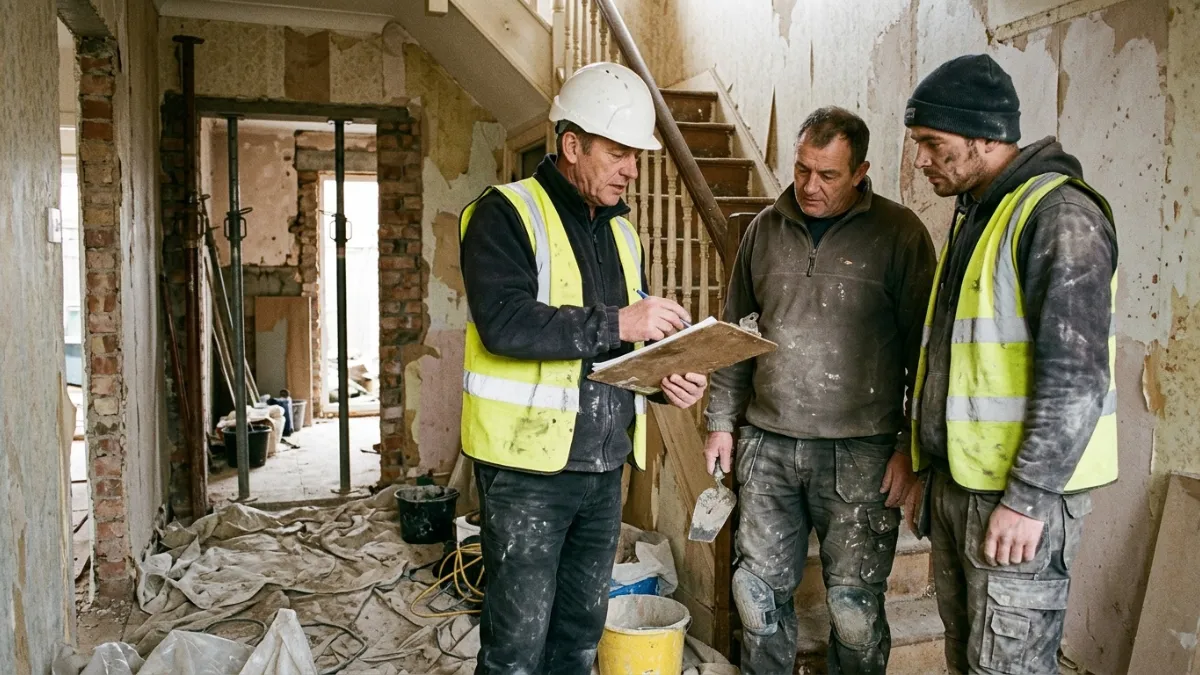
A method statement template gives you the headings; a RAMS is that template filled in for one job. It is two documents that travel together: a risk assessment, which says what could hurt someone on this particular job and how you will stop it, and a method statement, which sets out step by step how the work will actually be done. The risk assessment is a legal duty for employers and for self-employed builders. The method statement usually is not, but nearly every main contractor, facilities manager and council client will ask for one before you set foot on site.
Below you will find a free method statement and RAMS template you can paste onto your own letterhead, a simple way to score the risks, a filled-in RAMS for taking out a load-bearing wall, what the law in Great Britain actually requires and the mistakes that get RAMS sent back by site managers.
What RAMS are and what the law requires
RAMS stands for risk assessment and method statement. The risk assessment identifies the hazards of a specific task, who could be harmed and the controls you will use. The method statement describes the safe sequence of work, the people, plant and materials involved, and how those controls are applied on site. Together they show the job has been planned.
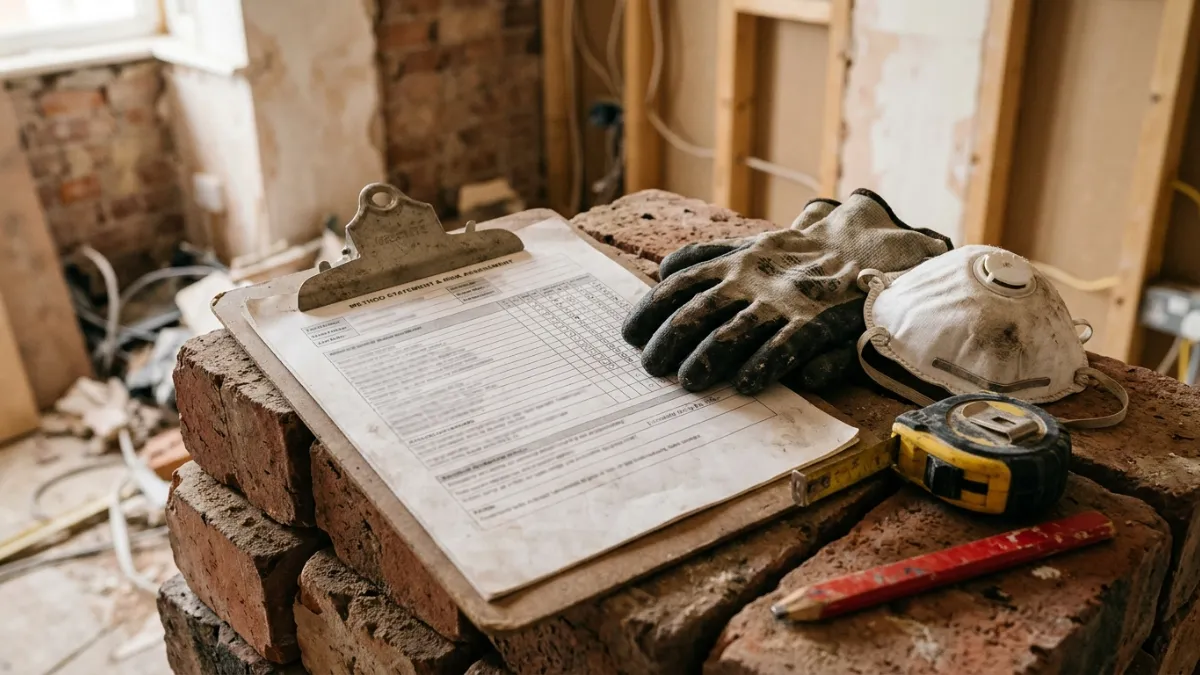
“RAMS” is industry shorthand, not a legal term. What the law asks for is spread across several sets of regulations:
| Document | Where the duty comes from | When you need it |
|---|---|---|
| Risk assessment | Management of Health and Safety at Work Regulations 1999, reg. 3 | Always. Significant findings must be written down if you employ five or more people |
| Method statement | No general duty. CDM 2015 reg. 20 requires the arrangements for demolition or dismantling to be recorded in writing, and HSE applies the same to structural alteration | Demolition and structural work, and whenever the client or principal contractor asks (most commercial jobs) |
| Construction phase plan | CDM 2015 regs. 12 and 15(5) | Every project, domestic ones included, written by the principal contractor or the only contractor |
| COSHH assessment | COSHH Regulations 2002, reg. 6 | Hazardous substances, including silica dust from cutting brick, block and concrete |
| F10 notification to HSE | CDM 2015 reg. 6 | More than 30 working days with over 20 workers on site at once, or more than 500 person-days |
Two points catch small firms out. First, the five-employee threshold only decides whether the risk assessment must be written; it never removes the duty to do one. And although most self-employed people were taken out of health and safety duties in 2015, work on a construction site is a prescribed activity, so a sole trader builder still has to assess the risks to themselves and to anyone their work affects.
Second, CDM applies to domestic jobs. Under regulation 7, the homeowner’s client duties pass to the contractor if you are the only one on the job, or to the principal contractor if there are several, unless the homeowner has agreed in writing that the principal designer will take them on. On a kitchen extension, that usually means you. In Northern Ireland the same structure applies through the NI versions of the Management Regulations (2000) and CDM (2016).
Method statement vs risk assessment
The risk assessment is the thinking; the method statement is the instructions. For the same task, the risk assessment might say “silica dust when cutting the opening: high risk; controls: water suppression, face-fit tested FFP3 masks, room sealed off”. The method statement turns that into a sequence: “Step 4: Dave cuts the opening with the cut-off saw on water feed, Tom keeps the bowser topped up, nobody else enters the kitchen until the floor has been wet-vacuumed.”
HSE describes a method statement as setting out “in a logical sequence exactly how a job is to be carried out”, built from the conclusions of the risk assessment. If a control appears in your risk assessment but not in a step of your method, ask yourself whether anyone will actually do it.
The construction phase plan sits above both. It covers the whole site: who is in charge, site rules, welfare, emergency arrangements and how trades are coordinated. RAMS cover individual tasks or trades. HSE’s leaflet for small builders, CIS80, says the plan does not need to be complicated and that a simple plan before work starts is usually enough; it even has a blank template on its second page. On a domestic job of a few weeks with one team, we would write a single document of four to six pages that does both jobs, rather than a plan plus a stack of task RAMS nobody reads.
What to include in a RAMS
- Job details: client, site address, principal contractor, dates, document reference and revision number.
- Scope: what the task is and, just as useful, what is excluded.
- People: named supervisor, team, first aider, and the training each task needs.
- Risk assessment: hazard, who could be harmed, risk before controls, the controls, residual risk and who is responsible.
- Sequence of work: numbered steps with the controls written into each one.
- Plant, equipment and substances: with inspection dates and COSHH sheets.
- PPE and RPE: specific items, not “PPE as required”.
- Welfare and site set-up: toilets, washing, drinking water, rest area, access and storage.
- Emergencies: nearest A&E, fire procedure, isolation points and how accidents are reported under RIDDOR.
- Sign-off record: signatures of everyone who has been talked through it.
When a site manager reviews your RAMS, they rarely read it front to back. They check that it names this site and this task, that the supervisor is a real person, that the emergency details are local, and that the sequence matches their programme.
Free method statement and RAMS template
Copy this into your word processor, add your logo and replace everything in square brackets. Delete sections that genuinely do not apply rather than writing “N/A” in them.
RISK ASSESSMENT AND METHOD STATEMENT (RAMS)
Ref: [RAMS-0xx]   Revision: [0]   Date: [dd/mm/yyyy]
Prepared by: [name, role]   Approved by: [name]

1. JOB DETAILS
Client: [name]          Site address: [address, postcode]
Principal contractor: [name or "N/A, single contractor"]
Start date: [ ]   Duration: [ ]   Working hours: [08:00-17:00]

2. SCOPE OF WORK
Task: [what you are doing, where in the building]
Excluded: [e.g. electrical alterations by others]

3. PEOPLE AND COMPETENCE
Site supervisor: [name, mobile]   First aider: [name]
Team: [names, trade, relevant training or card]

4. RISK ASSESSMENT
Hazard | Who could be harmed | Risk before | Controls | Residual risk | Responsible
[ ]    | [ ]                 | [L/M/H]     | [ ]      | [L/M/H]       | [ ]

5. SEQUENCE OF WORK
Step 1: [site set-up, protection, isolation]
Step 2: [ ]
Step 3: [ ]
Final step: [clean-down, waste removal, handover]

6. PLANT, EQUIPMENT AND SUBSTANCES
[item] - [inspection/test date] - [COSHH sheet yes/no]

7. PPE AND RPE
[e.g. safety boots, gloves (cut level), eye protection,
FFP3 face-fit tested to each wearer (clean-shaven),
hearing protection for breaker]

8. WELFARE AND SITE SET-UP
Toilets/washing: [ ]   Drinking water: [ ]   Rest area: [ ]
Access and material storage: [ ]   Waste: [skip/permit/carrier]

9. EMERGENCIES
Nearest A&E: [hospital, address]   Fire assembly point: [ ]
Isolation points: gas [ ] water [ ] electric [ ]
Accident reporting: [who reports, RIDDOR]

10. REVIEW
Review this RAMS if the scope, team, method or site conditions
change, or after any accident or near miss.

11. SIGN-OFF RECORD
I have been briefed on this RAMS and understand it.
Name | Company | Signature | Date
HSE’s own risk assessment template uses similar columns and carries a warning worth repeating: do not just copy an example and put your company name on it. The template is the skeleton. The value is in what you write for the job in front of you.
Scoring the risk: a simple matrix
The law does not require a scoring system, and plenty of good RAMS use none. Most main contractors expect one, though, and a score forces you to compare the risk before and after your controls. A three-by-three grid is enough for most small works; the five-by-five grids common on big sites add more boxes than a two-week domestic job needs.
| Likelihood / worst realistic outcome | Minor injury (first aid) | Injury that stops someone working | Major injury, ill health or death |
|---|---|---|---|
| Unlikely | Low | Low | Medium |
| Possible | Low | Medium | High |
| Likely | Medium | High | High |
Score each hazard twice. Uncontrolled silica dust from a cut-off saw is likely and causes lung disease, so it starts High; with water suppression, the right mask and the room sealed off it should come down to Low. If a line is still High after your controls, change the method rather than add another layer of PPE. And a Low that nobody believes, such as working off a stepladder on a stairwell, is worse than no score at all.
Worked example: RAMS for removing a load-bearing wall
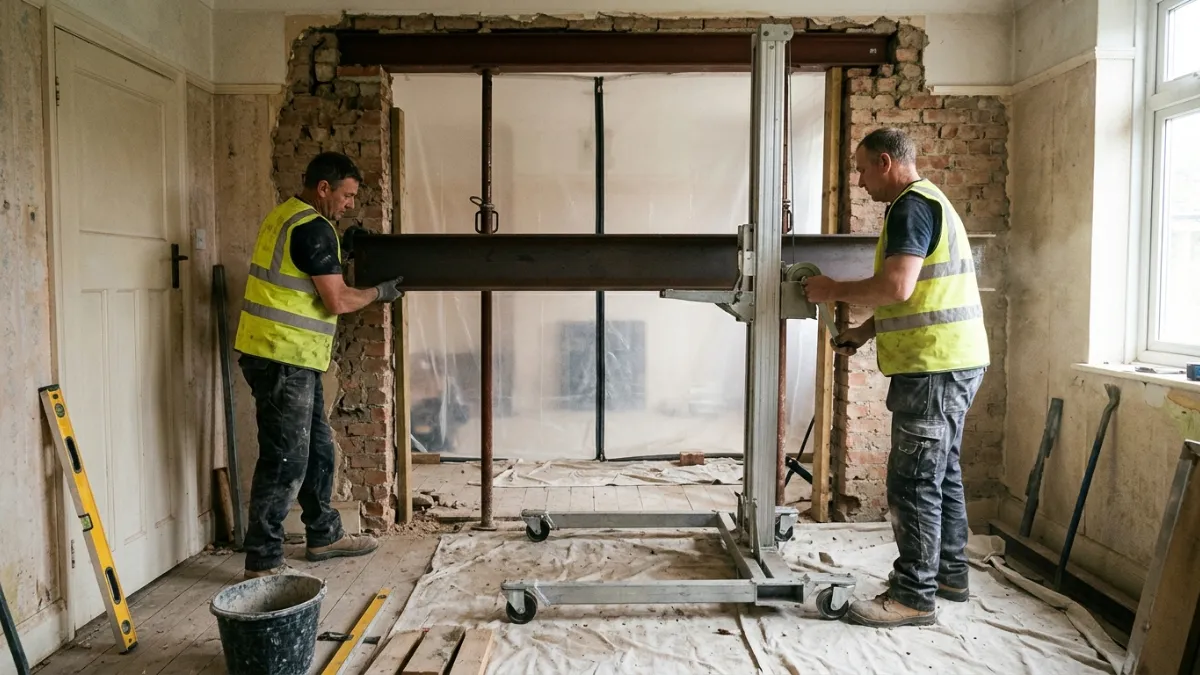
Example: a 1930s semi in Leeds. The owners want the wall between kitchen and dining room taken out to make a 3.6 m opening. The structural engineer has specified a 203 × 133 × 25 UB steel, 4.2 m long (about 105 kg), on padstones, and Building Control has approved the calculations. The family stays in the house. The team is two bricklayers and a labourer. Taking out a load-bearing wall is a structural alteration, and HSE says the arrangements for that must be recorded in writing before work begins.
| Hazard | Who | Controls | Residual |
|---|---|---|---|
| Collapse of masonry or floor above | Team, family | Needles and props at the spacing on the engineer’s temporary works sketch, on spreader boards; nobody under unsupported masonry; props checked each morning | Low |
| Silica dust from cutting brick | Team, family | Water suppression or on-tool extraction with an M-class vacuum; FFP3 masks face-fit tested to each wearer, worn clean-shaven; zip door sealing the room; wet-vacuum, never dry sweep | Low |
| Asbestos in textured ceiling or old boarding | Team, family | Refurbishment survey of the affected area before work; work stops if anything is found; asbestos awareness training for the team | Low once surveyed |
| Hand-arm vibration from the breaker | Operatives | Tool rated at 10 m/s² reaches the action value in 30 minutes: trigger time limited and rotated, low-vibration tool, exposure recorded | Low |
| Manual handling of the 105 kg steel | Team | Beam lifter, or a four-person lift on a cleared route; delivery to the front door; gloves | Low |
| Hidden services in the wall | Team | Cable and pipe detector, electrician disconnects circuits, water isolated where pipes run through | Low |
The vibration line deserves a number because that is where RAMS usually get vague. HSE’s exposure action value is 2.5 m/s² A(8), or 100 points, and the limit value is 5 m/s², or 400 points. A breaker vibrating at 10 m/s² builds 200 points an hour, so one person hits the action value after 30 minutes of trigger time and the legal limit after two hours. “Take regular breaks” is not a control; “maximum 30 minutes each, two operatives rotating” is.
The method statement then reads as a sequence:
- Protect floors and route, fit the zip door, agree with the family which rooms are out of bounds.
- Electrician isolates and disconnects circuits in the wall; detector sweep.
- Cut needle holes, install needles and props as drawn; supervisor checks before any masonry comes out.
- Cut the opening and remove masonry from the top down with dust controls running; rubble bagged straight to the skip.
- Build padstones to the engineer’s levels.
- Lift the steel into place on the beam lifter, pack and dry-pack to the engineer’s detail.
- Building Control inspection, then remove props once the packing has cured.
- Make good, wet-vacuum, remove the zip door and hand back the rooms.
Two things often missing from this kind of RAMS are not strictly safety items but stop jobs dead. If one end of the steel bears on the party wall, as it often does in a semi, the Party Wall etc. Act 1996 applies in England and Wales: the neighbours need written notice between two months and a year before that work starts. They have 14 days to consent in writing, and silence is not consent; it counts as a dispute and surveyors get appointed, so serve notice as soon as the engineer’s drawings are fixed. And if the skip goes on the road, the council permit has to be in place before it arrives.
Talking the team through it, sign-off and revisions
A RAMS that sits in the van has done half its job. Talk the team through it on the first morning, at the work area rather than in the café, and get signatures on the briefing sheet. Anyone who joins later gets the same briefing. Keep a copy on site, because an inspector will compare what is written with what they see, and the gap between the two is what gets you into trouble. A photo of the signed sheet in the site notes of your job management software for builders is a cheap backup when the paper copy ends up under a bag of plaster.
Revise the RAMS, bump the revision number and brief again when the scope changes, a new trade or new plant arrives, the weather changes the method (wet scaffolds, high winds on a roof), or after any accident or near miss. If HSE finds a material breach, its fee for intervention is £188 an hour for the inspector’s time, before any fine.
Writing a proper task-specific RAMS takes one to two hours, longer for demolition or work at height on a commercial site. That is real time, so put it in the preliminaries when you price the job, as in our building quote template. On main contractor work, expect the RAMS to be requested alongside your insurance certificates and the details they need to verify you under the Construction Industry Scheme, and do not expect to start until all three have been accepted.
Keep the document short and specific. Four to eight pages that the team has actually read beat forty pages of generic hazards. If you use the same RAMS for repeat tasks, review the site-specific parts every time: access, services, occupants, emergency details and who is on the team.
Common RAMS mistakes
- The generic RAMS. Last job’s document with the address changed, still mentioning a scaffold that is not there.
- Controls nobody can follow. “On-tool extraction” written down, no extractor in the van.
- PPE as the first answer. The hierarchy starts with removing or reducing the hazard: a smaller cutting method, water, extraction, then the mask.
- Assuming there is no asbestos. In a building put up or refurbished before 2000, find out before you drill or cut.
- Forgetting who else is there. Occupants, neighbours, delivery drivers, the public walking past the skip.
A template does not make you competent to assess every task. Structural alterations need an engineer’s design and temporary works details, suspected asbestos needs a survey before work starts, and some work, such as near overhead power lines, in excavations or with heavy prefabricated components, is listed in CDM Schedule 3 as carrying particular risks that the construction phase plan must address. If in doubt, get advice from a competent health and safety adviser.
Frequently asked questions
Is a method statement a legal requirement in the UK?
Not in general. The legal duty is the risk assessment, plus a construction phase plan under CDM 2015. Written arrangements are required for demolition, dismantling and structural alteration, and in practice most clients and main contractors make a method statement a condition of starting work.
Do I need RAMS for domestic jobs?
You need a risk assessment and a construction phase plan, because CDM applies to domestic work and the homeowner’s duties pass to you as contractor. A separate RAMS is not required by law, but on a short domestic job one short document can cover the plan and the RAMS together.
Who should write the RAMS?
The contractor doing the work, ideally the person who will supervise it, with input from the people doing the task. A consultant can help, but a RAMS written by someone who has never seen the site is the one most likely to be wrong.
Can I use a generic RAMS template?
As a structure, yes, and that is what the template above is for. As the finished document, no: HSE warns that copying an example and putting your name on it does not satisfy the law. Site address, access, services, occupants, team, plant and emergency details have to be written for the job, and that is exactly what site managers check first.
How long is a RAMS valid for?
There is no fixed expiry date. It stays valid while the task, site, team and conditions match what is written, and must be reviewed when any of them change or after an incident.
Do I need a written risk assessment if I have fewer than five employees?
The law only requires the findings to be recorded once you employ five or more people, but you still have to carry out the assessment. Any client or principal contractor will want it in writing anyway, so write it down.
Sources
Rules checked on 1 November 2026. Check your own case with a competent health and safety adviser.
- Management of Health and Safety at Work Regulations 1999, regulation 3
- Construction (Design and Management) Regulations 2015
- Health and Safety at Work etc. Act 1974 (General Duties of Self-Employed Persons) (Prescribed Undertakings) Regulations 2015
- HSE: construction paperwork and method statements
- HSE CIS80: Construction phase plan (CDM 2015), what you need to know as a busy builder
- HSE: domestic clients under CDM 2015
- HSE: risk assessment template and examples
- HSE: hand-arm vibration exposure calculator
- HSE: construction dust
- HSE: RPE fit testing basics
- HSE: introduction to asbestos safety
- GOV.UK: party walls and building work
- HSE: fees and charges, current rates
Every job’s paperwork in one file
A file for every job with its quotes, its invoices and site notes with photos from your phone, and quotes your clients sign online. €19.95/month · or €199.50/year with 2 months free · no tie-in.