
A UK hairdresser price list in 2026 typically sits around £45 for a women’s cut and blow-dry, £18 for a men’s cut and £90 for highlights. Those are the medians we calculated from the individual prices Office for National Statistics collectors recorded in salons and barbers in September 2026. Your own prices should start from what an hour in your chair costs: for a two-chair salon outside London that’s roughly £37 an hour before products, so about £39 for a one-hour cut and blow-dry and £107 for a full head of highlights.
The medians show what clients near you are used to paying. They don’t tell you whether you can afford to match them. So we work through both with real numbers, then stylist levels, home and care-home visits, VAT, the price display rules that changed in 2025, deposits, and a price list you can copy.
Hairdresser prices in the UK in 2026: what salons actually charge
The most solid public benchmark is the ONS. It doesn’t publish an average haircut price, but it does release every price quote its collectors record for the consumer prices index, and three of the items are hairdressing: a man’s haircut, a woman’s cut and blow-dry, and women’s highlighting. The table below is our own calculation from the September 2026 price quotes file, published on 21 October 2026. We kept the quotes ONS marks as valid (251 men’s cuts, 225 cut and blow-dries, 225 highlights), grouped its twelve regions into seven so each group has enough quotes, and took the plain median, without ONS’s shop weights. It isn’t an official ONS figure, but anyone can rerun it from the same file.
| Region | Men’s haircut | Women’s cut and blow-dry | Women’s highlights |
|---|---|---|---|
| UK, all quotes (middle half in brackets) | £18 (£14–£24) | £45 (£35–£57.50) | £90 (£72–£120) |
| London | £20 | £55 | £110 |
| South East | £20.50 | £57 | £116 |
| South West and East Anglia | £19 | £50 | £90 |
| East and West Midlands | £17.25 | £40 | £85 |
| North of England | £14.50 | £38.50 | £78 |
| Scotland | £15 | £47.75 | £97.75 |
| Wales and Northern Ireland | £14 | £35 | £85 |
Regional samples are small (15 to 60 quotes per cell) and the highlights item doesn’t say half or full head, so treat these as a guide, not a rate card. The trend is clear enough: ONS’s own index has hairdressing for women up 4.1% in the year to September 2026 and for men and children up 3.7%, against 3.5% for all items. And a median says nothing about whether the salon in the middle makes money.
Work out your cost per chair hour first
Cost per chair hour is everything it takes to keep a chair open for a year, your own pay included, divided by the hours that chair is actually booked and paid for. It’s the figure that tells you whether a £40 cut is a fair price or a slow loss.
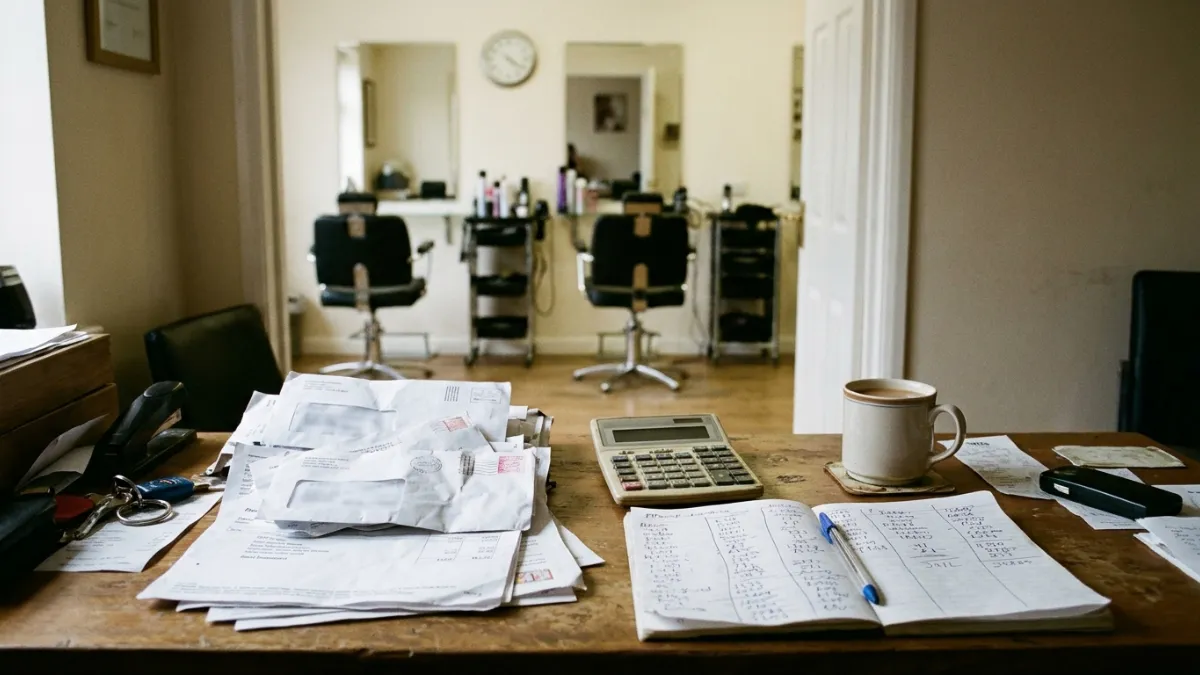
Take a two-chair salon in an East Midlands market town: the owner works the floor full time and employs one stylist on £13.00 an hour for 37.5 hours a week. Put your own figure on every line.
| Annual cost | Amount |
|---|---|
| Rent (£1,100 a month) | £13,200 |
| Business rates (100% small business rate relief in England, rateable value up to £12,000) | £0 |
| Energy and water | £4,200 |
| Insurance: public and products liability, treatment risks, employers’ liability | £850 |
| Card fees (about 1.5% of takings) | £1,300 |
| Software, phone, broadband and music licence | £1,200 |
| Laundry, towels, gloves, foils and sundries | £1,400 |
| Accountant, equipment repairs and replacement | £1,900 |
| Marketing and training | £1,400 |
| Overheads | £25,450 |
| Stylist’s wages: £13.00 × 37.5 h × 52 weeks, holiday pay included | £25,350 |
| Employer pension, 3% of qualifying earnings above £6,240 | £573 |
| Employer National Insurance (£3,053, covered by the Employment Allowance) | £0 |
| Owner’s target pay, before tax | £30,000 |
| Total to recover from the chairs | £81,373 |
Employer National Insurance is 15% on pay above £5,000 in 2026/27, and the £10,500 Employment Allowance cancels it for most small salons, though not for a company whose director is its only employee above that threshold.
Billable hours: the number almost everyone overestimates
Take off 5.6 weeks of statutory holiday and a week for sickness and training, and a 37.5-hour week becomes 1,702 hours on the floor. Then come the gaps: the unbooked 15 minutes, the late client, the free consultation, the dead Tuesday in January. A column 72% booked all year belongs to a busy stylist. The owner works a 40-hour week (1,816 hours on the same basis) but also orders stock and does the rota, so 65% is realistic.
That’s 1,226 + 1,180 = 2,406 billable hours, so £81,373 ÷ 2,406 = £33.82 per chair hour. Add 10% for profit and the dryer that dies in August, and you need £37.20 an hour, or 62p a minute, before products.
With both chairs only 60% booked, the rate climbs to £42.40 an hour; at 80% and 70% it drops to £34. In our experience, filling the gaps (rebooking at the mirror, a short waiting list, realistic appointment lengths) moves profit more than another 50p on the cut.
Re-run the sum every spring. The National Living Wage (21 and over) is £12.71 from April 2026, and on 28 October 2026 the government confirmed £13.21 from April 2027. This stylist’s £13.00 becomes unlawful then; moving her to £13.50 adds about £1,000 a year, or 46p a chair hour.
From hourly rate to price list: time plus product cost
Time-based pricing means each service costs the minutes it really takes in the chair, times your rate per minute, plus the product used. Measure product rather than guess: for a month, weigh every colour bowl on digital scales, count foils and toner, and cost it from your wholesaler invoices. Colour usually uses more than salons think, cuts far less.
| Service | Time in chair | Product (estimate) | At 62p/min + product | Menu price |
|---|---|---|---|---|
| Cut and blow-dry | 60 min | £1.50 | £38.70 | £39 |
| Short cut, clipper or scissor | 30 min | £0.50 | £19.10 | £19 |
| Blow-dry only | 40 min | £1.20 | £26.00 | £26 |
| Shampoo and set | 45 min | £1.50 | £29.40 | £29 |
| Child’s cut (under 12) | 20 min | £0.30 | £12.70 | £13 |
| Root colour with blow-dry | 90 min | £6.50 | £62.30 | £62 |
| Half head highlights with blow-dry | 105 min | £9.00 | £74.10 | £75 |
| Full head highlights with blow-dry | 150 min | £14.00 | £107.00 | £107 |
| Balayage with toner and blow-dry | 180 min | £18.00 | £129.60 | £130 |
Against the Midlands medians, the cut and blow-dry (£39 against £40 for a women’s cut and blow-dry) and the short cut (£19 against £17.25 for a men’s cut) sit comfortably. Full head highlights at £107 is a quarter above the £85 median. Check the timing before the price: either sell the result at that price or find 30 minutes with faster sectioning, an assistant or toning at the basin.
Two refinements. While a root colour develops for 35 minutes the stylist is free; if a short cut genuinely fills that gap most days, charge processing at half rate and the root colour drops to about £52. And long or thick hair deserves a supplement, provided it’s on the menu with a clear test (below the shoulder blades, or over 60 g of colour) and quoted at consultation. Sprung at the till, it’s the regulator’s own example of drip pricing.
Tiered pricing by stylist level
Levels charge for what really differs: speed, skill and demand. A higher price rations a senior’s time when she has a three-week waiting list, while a graduate needs a price that fills her column. This ladder works for most small salons:
| Level | Typical profile | Against base | Cut and blow-dry |
|---|---|---|---|
| Graduate stylist | First year or two after qualifying | −15% | £33 |
| Stylist | Fully trained, steady column | Base | £39 |
| Senior stylist | Five years or more, high rebooking | +15% | £45 |
| Director | Trains the team, waiting list | +35% | £53 |
We’d move someone up after three months running above 85% booked, with most clients rebooking. Show every level’s price on the menu so clients see the total before booking.
Avoid pricing by gender. The Equality Act 2010 bars worse terms because of someone’s sex, and a short crop takes 30 minutes on anyone. Pricing by length or time (short, medium, long) is fairer and easier to defend.
Mobile hairdresser prices, including care homes and elderly clients
A mobile hairdresser has no rent but loses hours to the road. Say you aim for £28,000 profit, with £4,500 of yearly costs (insurance, kit, products, phone) and 6,000 business miles at HMRC’s simplified 45p a mile (£2,700). Thirty client hours a week for 45.4 weeks is 1,362 hours, so (£28,000 + £4,500 + £2,700) ÷ 1,362 = about £26 an hour: around £28 for a wash, cut and blow-dry at home, £21 for a shampoo and set. Set a minimum visit charge (£20, say), since a £14 trim with 40 minutes’ driving loses money, and price distance openly.
Care homes work differently. A regular morning might be four shampoo and sets at £18, two cuts at £16 and a perm at £45: £149 for four and a half hours. That’s £33 an hour, better than home visits, because there’s no driving and the sets overlap under the dryer. Expect to show a DBS certificate and public liability insurance, and agree in writing who pays. If the home settles a monthly invoice, list residents and services (see what a sole trader invoice must include); a business paying late owes you statutory late payment interest, though families paying directly don’t.
The £90,000 VAT threshold and what it does to your prices
Back to the two-chair salon. At £37.20 an hour across 2,406 hours its services bring in about £89,500, and with product recharges and some retail, takings reach around £96,000: over the £90,000 VAT threshold, which is tested on takings over any rolling 12 months, not profit. Our guide to the VAT threshold in 2026 covers the tests; here the question is who pays the 20%. Take the £39 cut and blow-dry, which needs £38.70:
| Approach | Menu price | VAT to HMRC | You keep |
|---|---|---|---|
| Not VAT-registered | £39 | £0 | £39.00 |
| Registered, price unchanged, standard accounting | £39 | £6.50 | £32.50 |
| Registered, price unchanged, Flat Rate Scheme 13% | £39 | £5.07 | £33.93 |
| Flat Rate Scheme 13%, price raised to £45 | £45 | £5.85 | £39.15 |
| Standard accounting, full 20% added | £47 | £7.83 | £39.17 |
The Flat Rate Scheme rate for hairdressing is 13% of VAT-inclusive takings, 1% less in your first year of registration, and you can join if you expect taxable turnover of £150,000 or less in the next 12 months. You can’t reclaim VAT on costs (except capital items of £2,000 or more), and the 16.5% limited cost rate applies if goods cost under 2% of turnover or £1,000 a year, rare for a salon buying colour by the case. Standard accounting reclaims VAT on products, equipment, energy and VAT-able rent, so have your accountant compare both on your real costs.
Few salons can move a £39 cut to £47 overnight. What works is a staged rise: half the VAT when you register, the rest at the April review, with colour (where clients compare less) carrying more. Cutting hours to stay under £90,000 caps your income too. Either way keep digital records: sole traders with qualifying income over £50,000 have been in Making Tax Digital for Income Tax since April 2026, and those over £30,000 join in April 2027.
How to display your prices legally: drip pricing and the DMCC Act
Since 6 April 2025 the Digital Markets, Competition and Consumers Act 2024 has replaced the Consumer Protection from Unfair Trading Regulations 2008. Under section 230, an invitation to purchase (your price list, your window card, your booking page) must show the total price, including VAT and every fee the client can’t avoid. Where the total genuinely can’t be worked out in advance, you must say how it will be calculated, as prominently as the prices themselves. The Competition and Markets Authority can now fine directly, up to 10% of worldwide turnover, and Trading Standards enforce the same rules locally.

Salons star in the CMA’s price transparency guidance (CMA209): its drip pricing example is a price list showing a £50 cut, with a £25 long-hair fee added at the till. On a salon menu that means:
- VAT-inclusive prices if you’re registered, and no booking, admin or towel fees added later.
- Supplements on the menu with the rule that triggers them, and the full total given at consultation.
- A “from” price only if a real share of clients pay it.
- Where the price depends on the hair, the rule that sets it (time, grams of colour) printed next to the prices, not in small print.
Two charges you can’t add to a consumer’s bill. Card surcharges on consumer payments are banned under the Consumer Rights (Payment Surcharges) Regulations 2012, so build card fees into prices. A compulsory service charge is a mandatory fee that belongs in the headline price. Voluntary tips are fine, but under the Employment (Allocation of Tips) Act 2023 tips, and any service charge you add, must be passed to your staff in full. Unsure about a charge? Ask Trading Standards or a solicitor.
Deposits, cancellation fees and no-show policies that hold up
A Saturday no-show on a three-hour balayage costs our example salon about £112 of chair time. Deposits are the answer, but the Consumer Rights Act 2015 requires fair terms; its grey list flags fees out of proportion to your loss, or keeping money when you’d owe nothing if you cancelled.
A policy likely to stand up: a 20% to 25% deposit on colour and appointments over 90 minutes, counted towards the bill; a full refund or free move for cancellations 48 hours ahead; the deposit kept for later cancellations and no-shows; a full refund if the salon cancels. A no-show fee on a saved card needs clear advance agreement, and 50% of the price is easier to justify than 100%, as you haven’t used the colour.
Online and phone bookings add a wrinkle; bookings made at your desk don’t. Bookings taken remotely are usually distance contracts, and the Consumer Contracts Regulations 2013 give the client 14 days from booking to cancel for a refund. The exemption in regulation 28(1)(h) covers accommodation, transport of goods, vehicle rental, catering and “services related to leisure activities” booked for a specific date. Whether a haircut counts as leisure hasn’t been tested in court, and we wouldn’t bet a policy on it. On that cautious reading, a client who books on Monday for Saturday and cancels on Thursday may be owed the deposit, whatever your terms say. Two practical points follow. Your booking confirmation must tell clients about the right to cancel, or the 14 days can stretch by up to 12 months. And you need their express request to carry out the appointment within those 14 days (a tick box works). A plain no-show on the day leaves you on firmer ground, but take advice before relying on non-refundable deposits for short-notice online bookings.
If you’re VAT-registered, the deposit you keep isn’t compensation outside the scope of VAT. HMRC’s manual says a deposit retained when the contract is cancelled “remains consideration for a supply and is taxable” (VATSC05821), so if £130 is your VAT-inclusive balayage price, the £32.50 deposit you keep still contains £5.42 of VAT. The same goes for a no-show fee taken from a saved card.
Hairdresser price list template (copy and adapt)
Here is the example menu as a price list, with the policy lines that keep it compliant. The figures are before VAT registration; if you’re registered, use your VAT-inclusive prices.
[SALON NAME] · PRICE LIST · From [date]
All prices include VAT at 20%.  (or: We are not VAT registered.)

CUTTING AND STYLING       Graduate  Stylist  Senior  Director
Short cut (30 min)           £16      £19      £22     £26
Cut and blow-dry (60 min)    £33      £39      £45     £53
Blow-dry (40 min)            £22      £26      £30     £35
Shampoo and set (45 min)     £25      £29      £33     £39
Child's cut, under 12 (20 min)        £13

COLOUR (includes blow-dry)
Root colour (90 min)                  £62
Half head highlights (105 min)        £75
Full head highlights (150 min)        £107
Balayage with toner (180 min)         £130
Long or thick hair (below the shoulder blades
  or over 60 g of colour)             + £15
Skin test, 48 hours before colour     free

HOME VISITS  Within 5 miles: menu price · £1 per extra mile · minimum £20

DEPOSITS AND CANCELLATIONS
- Colour and appointments over 90 min: 25% deposit, taken off your bill.
- Cancel or move 48 hours ahead or more: full refund or free move.
- Later cancellation or no-show: deposit kept.
- If we cancel, your deposit is refunded in full.
- Booked online or by phone? Your confirmation explains your
  14-day right to cancel.
- Your price is confirmed at consultation, before we start.
- No extra charge for paying by card.
Keep it in a spreadsheet with columns for minutes, product cost and price per level, and next April’s review takes ten minutes. The sheet imports into the hair and beauty versions of Gremio Software, which bring in services from Excel or CSV with a preview.
Frequently asked questions
How much does a haircut cost in the UK in 2026?
Our medians from the ONS September 2026 price quotes are £18 for a man’s haircut, £45 for a woman’s cut and blow-dry and £90 for highlights. London and the South East run about £2 higher for a men’s cut and £10 to £26 higher for women’s services, while the North, Wales and Northern Ireland sit below the UK figure.
How much do mobile hairdressers charge for elderly clients?
On our example costs, about £21 for a shampoo and set and £28 for a wash, cut and blow-dry at home, with a minimum visit charge. Care-home prices per resident are lower, because several clients in one visit means no driving between them.
Can a hairdresser charge more for long hair?
Yes, if the supplement and the rule that triggers it are on your price list and the client hears the total before you start. Adding it at the till is the drip pricing the CMA’s own guidance uses as an example.
Should my salon price list include VAT?
If you’re VAT-registered, yes: consumer prices must include it. If you aren’t, you can’t charge VAT at all, and saying “We are not VAT registered” on the list avoids questions.
How often should a salon raise its prices?
Once a year, ideally in April when wages rise: the National Living Wage goes from £12.71 to £13.21 in April 2027. Re-run your chair-hour cost and give regulars a few weeks’ notice.
Can a hairdresser charge a cancellation or no-show fee?
Yes, if the client agreed to it before booking and it’s in proportion to what you actually lose, such as a deposit of 20% to 25% kept for late cancellations. For online and phone bookings, a client who cancels within 14 days of booking may be entitled to a refund under the Consumer Contracts Regulations, so take advice before making those deposits non-refundable.
Sources
Rates, thresholds and legislation checked on 1 November 2026. Regional price medians are our own calculation from the ONS file below. Also checked: HMRC rates and thresholds for employers 2026 to 2027, ONS CPI series L7TJ, L7TI and D7G7, and section 230 of the DMCC Act 2024. Check your own case with an accountant or adviser.
- ONS: CPI item indices and price quotes (September 2026 file)
- GOV.UK: National Minimum Wage and National Living Wage rates
- GOV.UK: VAT Flat Rate Scheme percentages
- CMA: Price transparency guidance (CMA209), 18 November 2025
- Consumer Contracts Regulations 2013, regulation 28
- HMRC VATSC05821: deposits as consideration
Your salon diary and till in one place
Diaries per stylist and chair, colour records with each visit’s formula, an online booking page with your logo, an email reminder the day before and a daily cash-up. €19.95/month · or €199.50/year with 2 months free · no tie-in.